

Key Takeaways
The EIA’s Annual Energy Outlook 2026 predicts more natural gas combined-cycle capacity deployed from 2025 to 2050.
Levelized costs remain higher due to some Biden-era regulations still on the books, which force the retirement of coal plants and limit new combined-cycle plants to an annual capacity factor of 40%.
The EIA sees electricity demand growth rates as slower than in the last five years, with growth concentrated in traditionally strong data center regions, including Virginia and Texas.
Total generation grows between 25% and 50% through 2050 across the cases the EIA considered, while total installed electric generating capacity increases between 50% and 90% across those cases, depending on the share of fossil fuels versus renewables permitted by the assumptions.
The Energy Information Administration (EIA) released its Annual Energy Outlook 2026 on April 8 with a different outlook for the generating sector compared to last year’s outlook. The 2026 outlook incorporates laws and regulations in effect as of December 2025 — mainly the One Big Beautiful Bill Act, signed in July 2025. That law phases out subsidies for intermittent wind and solar technologies.
The agency forecasts an increase in natural gas combined-cycle generating capacity, while still punishing its levelized cost with Biden-era regulations still on the books. According to the EIA, the 2024 Section 111 rule that limits new combined cycle turbines to an annual 40% capacity factor (unless carbon capture and sequestration technology is installed) was still in place in December 2025 and technically still is now, despite the underlying Endangerment Finding having been rescinded. When that limitation is removed, there is less wind and solar capacity built by 2050, and fewer coal plant retirements, as that rule also affects coal plants.
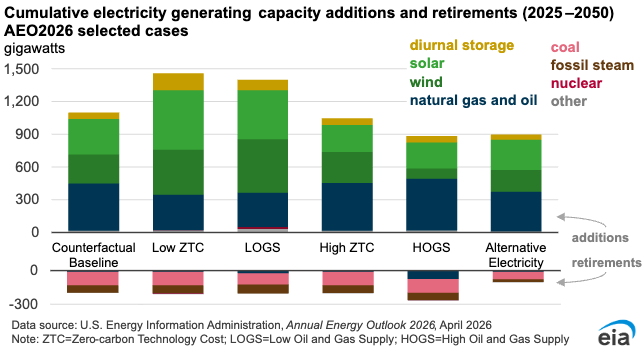
The result of the removal of the Sec. 111 rule is located in the “Alternative Electricity” case. Since coal and gas plants can produce two to three times more power generation per kilowatt than intermittent renewable energy can when they are allowed to function to their full capability, that case has a lower total capacity built in 2050 for solar, wind, and natural gas facilities.
The outlook expects electricity demand will grow through 2050 at a rate of 0.9% to 1.6%, as data centers continue to increase electricity demand. Over the last five years, electricity demand has increased by an average of 2.1%, so EIA sees future electricity growth declining. Data center server electricity use grows fastest in the South Atlantic and the West South Central census divisions, where Virginia and Texas, respectively, are located. Data server activity has been the greatest in these states.
Total generation grows between 25% and 50% through 2050 across the cases the EIA considered, while total installed electric generating capacity increases between 50% and 90% across those cases. Natural gas, solar, and wind are technologies primarily built to meet new demand and replace retirements. The combined generation share of these technologies increases from about 60% in 2025 to around 80% in most cases by 2050. In the Counterfactual Baseline case, natural gas accounts for about 40%, wind for 20%, and solar for 20% in 2050. Among the cases, natural gas’s share remains about the same.
The outlook’s assumptions result in massive coal retirements in most cases, as depicted below. In 2025, coal’s share is 16%. It declines to 1% by 2050 in most cases because climate policies are assumed. In the Alternative Electricity cases, it is around 5%. The EIA projects between 100 gigawatts and 125 gigawatts of coal capacity retirements by 2050 — about 65% to 80% of the coal fleet — across all cases, except the Alternative Electricity cases. In these cases, where climate policies and regulations are no longer in effect, cumulative coal retirements decrease to about 70 gigawatts — just over half of the retirements projected in the other cases. In cases in which these regulations remain in place, about 25 to 40 gigawatts of coal plants convert to natural gas and coal co-firing before they ultimately retire by 2038.
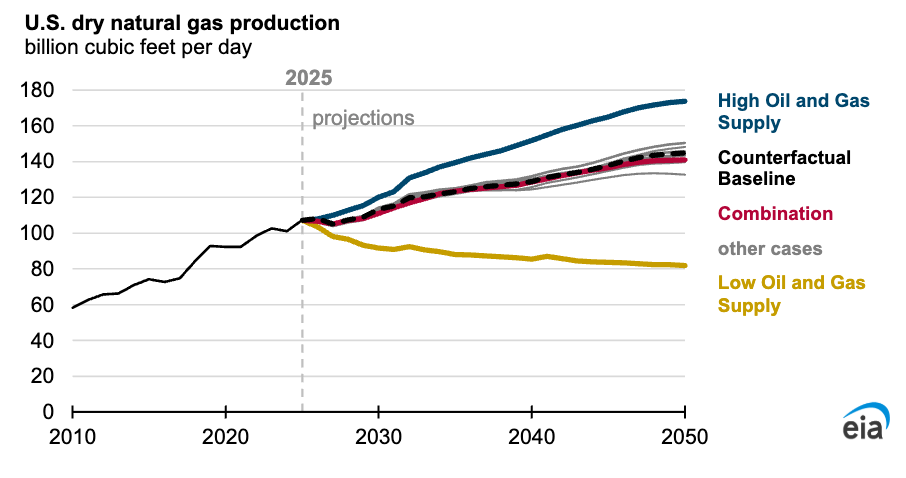
Natural gas demand not only increases due to increases in the generating sector but also because of expanding liquefied natural gas (LNG) exports. U.S. dry gas production increases up to 40% through 2050 from 2025 levels among the cases. The EIA projects LNG exports will rise from about 15 billion cubic feet per day in 2025 to more than 30 billion cubic feet per day by 2050.
Electric power consumption of natural gas increases by between 2.9 billion cubic feet per day and 15.2 billion cubic feet per day in 2050, in most cases, from the 35.2 billion cubic feet per day consumed in 2025 — more growth than in any other domestic end-use sector. Most of the natural gas production growth is expected to serve international markets, with export volumes highest in scenarios where emissions-reducing policies are absent. The Counterfactual Baseline case projects domestic U.S. natural gas consumption will increase from 90.8 billion cubic feet per day in 2025 to 108 billion cubic feet per day in 2050 — an increase of 19%.
Analysis
As the EIA’s Annual Energy Outlook 2026 shows, natural gas’s usage in electricity generation was set to be hindered by the Biden administration’s regulations. The Trump administration and congressional Republicans have taken a different approach over the past year, focusing on cutting regulatory barriers and subsidies alike. When it comes to lowering costs and improving environmental quality, this approach has proven successful. As the author Michael Magoon argues, “if you are concerned about lowering global carbon emissions while maintaining economic growth, natural gas is a no brainer.”
For inquiries, please contact wrampe@ierdc.org.

