

Key Takeaways
China has a goal to install 180 gigawatts of battery energy storage systems by the end of 2027, with a direct project investment of $35.2 billion.
China’s installed battery storage base at the end of 2024 totaled 73.8 gigawatts, 40% of the global total.
If China reaches its goal, the country would have almost as much battery storage installed by the end of 2027 as the entire world did through September 2025, when total operational battery storage capacity globally hit 189 gigawatts — a 28% increase over 2024.
Large-scale battery storage systems are charged during off-peak hours when excess power is available from wind and solar units and discharged during peak times when those power sources are dormant.
As reported by Energy Storage News, China plans on building an installed base of large-scale energy storage — primarily lithium-ion battery energy storage systems — to reach 180 gigawatts by the end of 2027, driving $35.2 billion in direct project investment. China is the world’s leading adopter and producer of energy storage technologies, likely making the goal achievable. The country’s installed base at the end of 2024 totaled 73.8 gigawatts (168 gigawatt hours), which represents a 130% year-on-year increase and about 40% of the global total. If China reaches its goal, it would mean that the country would have almost as much battery energy storage installed by the end of 2027 as the entire world did through September 2025, when total operational battery storage capacity globally hit 189 gigawatts (457 gigawatt hours) — a 28% increase over 2024. Large-scale battery storage systems are charged during off-peak hours when excess power is available from wind and/or solar units and discharged during peak times when those power sources are dormant.
Apparently, China succeeded in its goal of adding more than 65 gigawatt hours of battery energy storage systems in December 2025, which exceeded the total installed in the United States for the entire 2025 year by more than 15 gigawatt hours. The majority of that capacity was added in Inner Mongolia (about 65%), with Xinjiang adding about 14%.
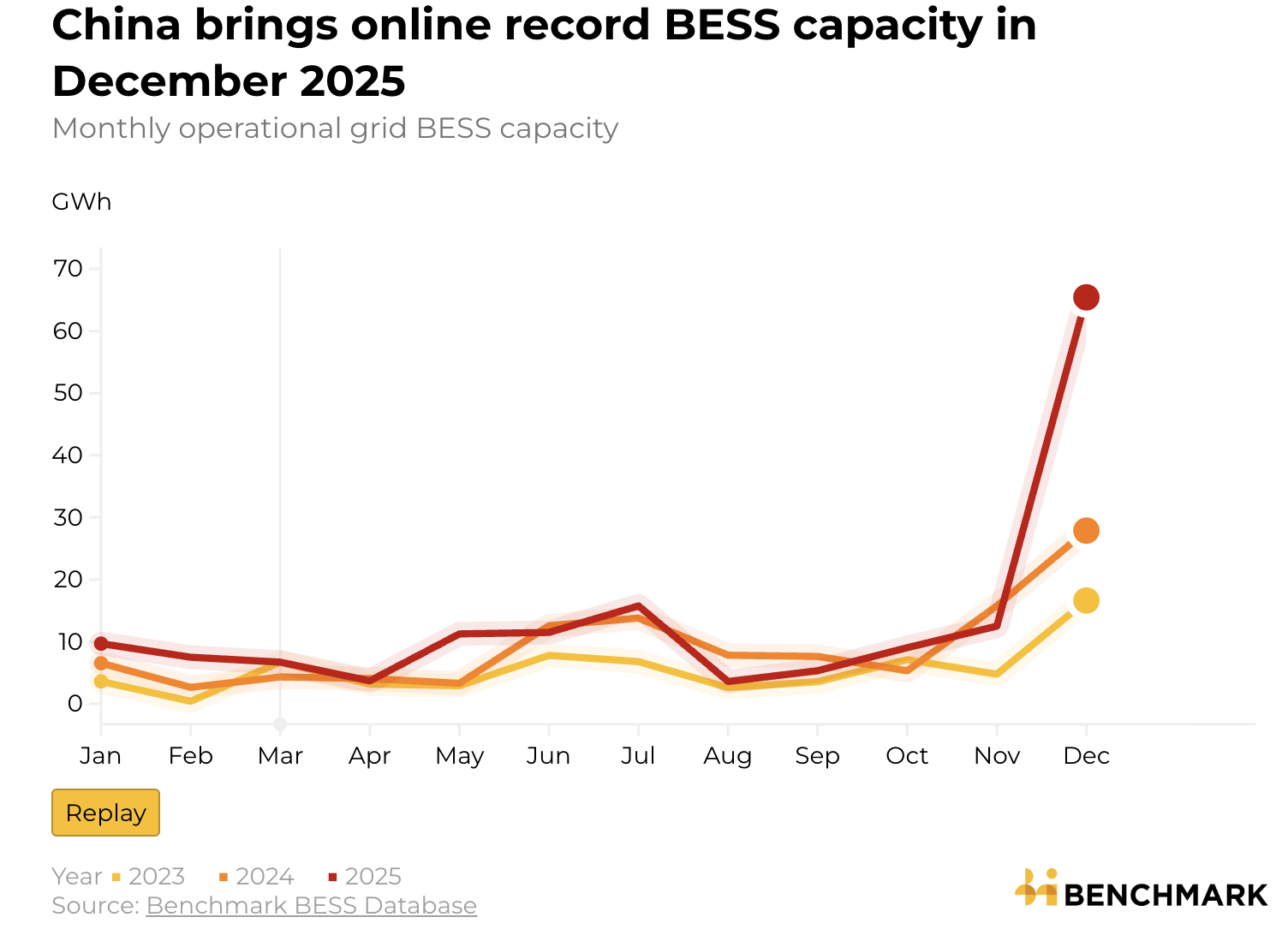
China’s December additions of 65 gigawatt hours of battery storage made up 92% of the 71-gigawatt hours that came online worldwide in the final month of 2025. For the entire 2025 year, over 246 gigawatt hours of grid-scale battery storage came online, of which 66% was installed in China, 19% in the United States, and 4% in Europe. The 246-gigawatt hours were a 46% increase over 2024 battery storage installations.
After China, the United States added the second most battery storage facilities in 2025 — about 47 gigawatt hours — an increase of 19%. California and Texas lead the states in energy storage. Europe added over 10 gigawatt hours of new large-scale battery storage capacity in 2025, an increase of 28%, of which the majority was added in the United Kingdom, which had four gigawatt hours enter operation, an increase of 34%. Australia added 9.8 gigawatt hours in 2025, an increase of 216%, and is expected to continue a high level of growth in 2026.
According to Nikkei Asia, China is expected to install 239 gigawatt hours of new capacity in 2026, making up more than half the 458.5-gigawatt hours expected to be installed globally. Expectations are for only 79.25 gigawatt hours of battery energy storage systems to be installed this year in North America, up from 57.8 gigawatt hours installed last year.
China dominates lithium-ion battery production and is home to some of the world’s biggest battery makers, CATL and BYD, benefiting from the worldwide boom in demand for batteries used in electric vehicles.
Project cancellations in the United States between January and November of last year jumped 340% to 54, while China recorded 181 project cancellations, compared with just two in the same period of 2024, reflecting the large amount of competition in the market.
Analysis
China is pushing ahead with battery storage to improve the reliability of its solar and wind facilities. Battery storage systems are considered a peak technology, but they do not generate power; they store it to be used during times of peak demand. They are also very expensive and have specific land requirements, needing huge tracts of land for the large battery systems and the associated transmission and distribution infrastructure. Often, they are co-located with wind and solar generating facilities for efficiency. However, even the combination of renewable energy and batteries can’t match the cost-effectiveness and reliability of a grid that primarily relies on dispatchable electricity sources, such as natural gas, nuclear, and coal.
For inquiries, please contact [email protected].

