

Key Takeaways
The United States is pressing European countries that have not released all the emergency stocks pledged under the IEA-led stock drawdown in the early weeks of the Iran conflict to do so now, focusing on diesel.
The Trump administration has asked the EU to release 120 million barrels of diesel over the next 6 months — over a third of the approximately 315 million barrels EU countries held in reserve as of June—to help ease diesel prices.
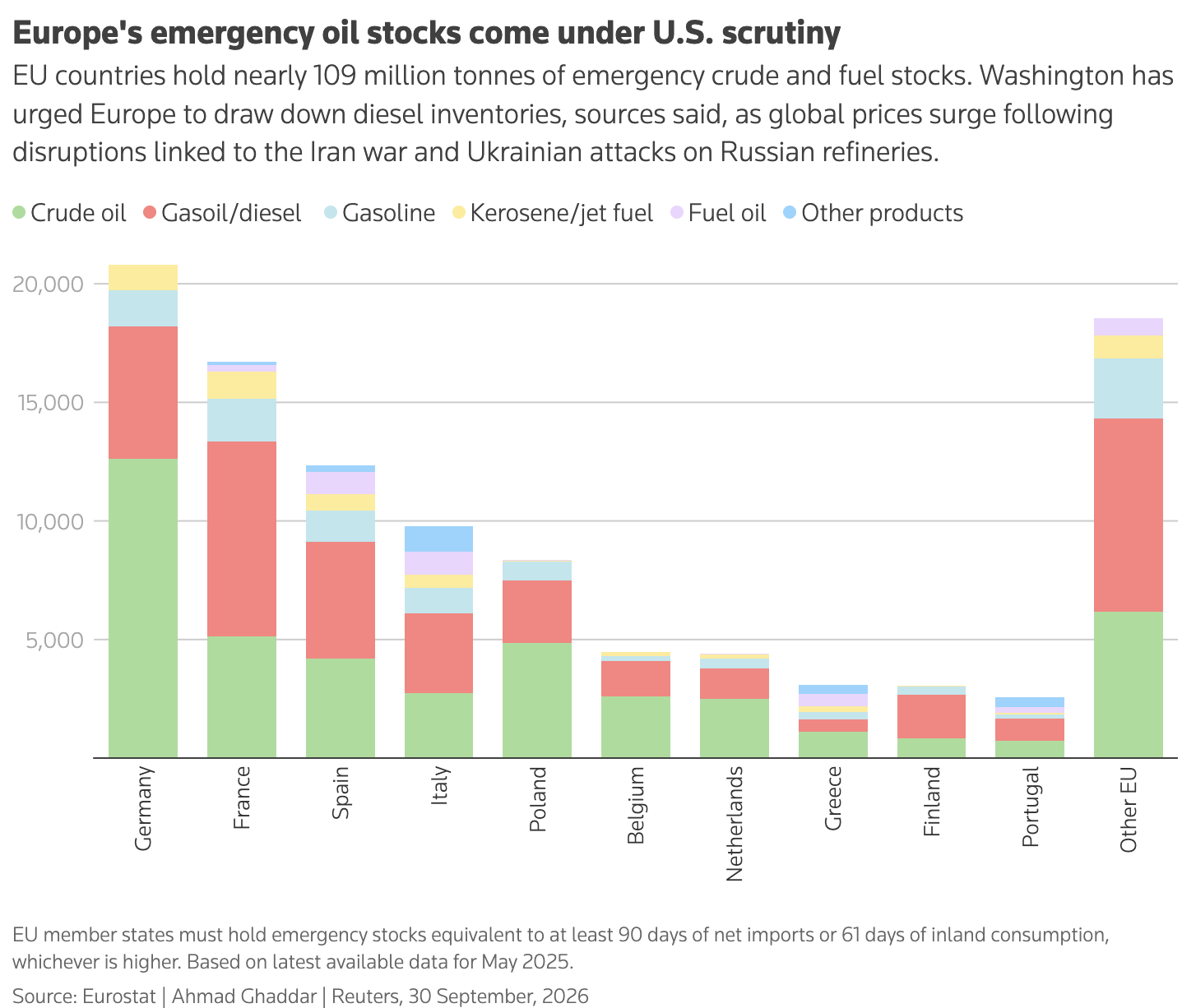
Germany and France hold about 35% of the EU’s strategic diesel reserves, estimated at about 39 million tons of diesel — equivalent to more than two months’ consumption for the bloc.
EU nations have closed or converted dozens of their refineries to make biofuels, and their diesel production has dropped significantly, increasing their reliance on the United States for petroleum products.
Oil transiting the Strait of Hormuz is now at prewar levels as the U.S. Navy assists with the shuttle transfer of oil from the Gulf to the Oman coast, but refined products are still at about 20% of their prewar level.
The Trump administration wants Germany and France to release emergency diesel inventories to help to ease global prices or face a potential U.S. diesel export ban. The administration has been frustrated with France and Germany, which it believes have not fully followed through on earlier commitments to release emergency oil and petroleum product stocks. The United States has asked the EU to release 120 million barrels of diesel– over a third of the approximately 315 million barrels of diesel EU countries held in reserve as of June this year–over the next six months—a fuel that Europe uses to power the majority of its vehicles.
According to Germany’s economy ministry, the International Energy Agency (IEA) has not yet asked Germany to release its stocks. The EU is balancing the need to bring down fuel prices at home with maintaining high stocks for a possible worsening of the fuel situation. In the meantime, it has become increasingly dependent on the United States for fuel supplies after it banned Russian imports over Russia’s invasion of Ukraine, after the Iran conflict disrupted supplies from the Middle East, and after it closed or converted dozens of refineries to biofuels since 2009 as part of its climate agenda.
After Ukrainian drones struck many of Russia’s refineries, Russia placed a ban on diesel exports beginning in July. Those attacks have continued, and Russia has extended the ban until the end of October, adding further strain on the market. China banned petroleum exports beginning in March to lower its need for oil imports, reinstating those exports somewhat in July, but Chinese refiners again suspended fuel exports in October to bolster domestic stocks. China has prepared itself for a Middle East oil crisis by building up stocks to 1.4 billion barrels and manufacturing electric vehicles for domestic and export markets, while providing incentives to its EV industry, thereby reducing oil import demand. Electric vehicles make sense for China as it has few oil and gas resources of its own, but can build electric vehicles using its huge coal fleet.
Energy Secretary Chris Wright said the U.S. administration expected announcements from Europe soon about new diesel supplies. Earlier, Wright said, “While the United States and Japan are delivering on their commitments, several European member countries have released only a fraction of the crude oil and petroleum products they pledged. We urge every member country to fulfill its commitments.” The United States is pressuring European countries that have not released all the emergency stocks pledged under the IEA-led stock drawdown in the early weeks of the Iran conflict to do so now. Germany and France hold about 35% of the EU’s strategic diesel reserves, estimated at about 39 million tons of diesel — equivalent to more than two months’ consumption for the bloc. EU Commission spokesperson Anna-Kaisa Itkonen indicated that any stock releases would be agreed through the International Energy Agency, a Paris-based institution that coordinates energy policy among OECD countries and oversaw an earlier stock release this year.
The United States expects the situation in the Middle East to improve, as ship traffic through the Strait of Hormuz, with the help of the U.S. Navy, has brought daily oil exports back to prewar levels. More than 70% of the crude oil that crossed Hormuz in August switched tankers off the coast of the United Arab Emirates or Oman, using shuttle tankers to bring oil through Hormuz to the Gulf of Oman. The cargo is then loaded onto another tanker that delivers it to Asia.
Crude transiting the strait averaged 13.5 million barrels per day as of September 28, matching a prewar baseline for shipments through the strait, according to data published by Kpler, a firm that tracks tankers and global trade flows. Saudi Arabia’s East-west pipeline and the UAE’s pipeline have also redirected oil flows. About 40% of Gulf crude oil now bypasses Hormuz through these pipelines, compared with 17% before the war. Despite that, Brent oil prices remain volatile, hovering around $100 a barrel.
Crude oil shipments from the Middle East region, including the Persian Gulf and Red Sea, are sometimes higher than prewar levels. The region reached a seven-day average of 19.5 million barrels per day as of September 28, surpassing a prewar baseline of about 17 million barrels per day. While the crude oil market has normalized, the refined petroleum market is still constrained. Refined products shipped through Hormuz averaged 677,000 barrels per day over the seven days ending September 28, compared with 3.6 million barrels per day before the war—an 80% drop.
Conclusion
The United States is pressuring European countries that have not released all the emergency stocks pledged under the IEA-led stock drawdown in the early weeks of the Iran conflict to do so now. The Trump administration has asked the EU to release 120 million barrels of diesel over the next 6 months–over a third of the approximately 315 million barrels of diesel EU countries held in reserve as of June this year—to help ease diesel prices. Germany and France hold about 35% of the EU’s strategic diesel reserves, estimated at about 39 million tons of diesel — equivalent to more than two months’ consumption for the bloc. Oil transiting the Strait of Hormuz is now at prewar levels as the U.S. Navy assists with the shuttle transfer of oil from the Gulf to the Oman coast. But refined products remain at about 20% of prewar levels.

