

Key Takeaways
The Russian invasion of Ukraine and the conflict in Iran have increased U.S. exports of crude oil, LNG, and refined products, as the United States is seen as a secure, reliable producer and exporter of these fuels.
Countries in both Europe and Asia are major importing countries that have had to purchase cargoes from the United States instead of Russia and the Middle East due to sanctions on Russia and Iran and the U.S. blockade of Iranian ports.
The new trade flow patterns have the United States accounting for more than 30% of global LNG gas trade, up from about 5% in 2018, and 10% to 15% of crude oil trade, about triple from its earlier 3% to 5% range.
The United States is the world’s largest producer of oil and natural gas, and its flexible export portfolio covers everything from crude oil and LNG to natural gas liquids, refined fuels, and petroleum coke.
Because U.S. exports often require longer transit times and higher shipping costs than supplies from the Gulf region, future gains in trade flows may depend on rising global consumption, competitive pricing, and the ability to attract new customers.
The U.S. industry’s resourcefulness and track record of shifting from a major importer to a major exporter of energy make continued success a likely bet.
The United States now accounts for more than 30% of global liquefied natural gas trade, up from about 5% in 2018, while its share of crude oil exports has roughly tripled from 3% to 5% to about 10% to 15%. Once one of the world’s largest net energy importers, the United States is now a dominant exporter of crude oil, liquefied natural gas, propane, diesel and petrochemical feedstocks. Thanks to advances in applied technology and investments in horizontal drilling and hydraulic fracturing, areas once thought lacking in hydrocarbons are producing in spectacular fashion. The United States is the world’s largest producer of oil and natural gas; its export portfolio covers everything from crude oil and LNG to natural gas liquids, refined fuels and petroleum coke. U.S. suppliers can tap multiple markets and shift volumes toward whichever products offer the strongest returns—an advantage other exporters do not have, such as Qatar with LNG and Saudi Arabia with crude oil. U.S. exporters were able to make these gains largely because of Europe’s break with Russian energy supplies following its invasion of Ukraine and instability in the Middle East from the Iran conflict. Buyers that seek security and reliability increasingly turned to American energy supplies.
According to a Reuters journalist, the next phase of U.S. export growth, however, will likely depend less on disruptions to rival suppliers and more on rising global consumption, competitive pricing and the ability to attract new customers. Major competing LNG export projects are advancing in Qatar, Canada, the United Arab Emirates, among others, which will increase competition for buyers in Europe and Asia. When Middle East supplies return to normal, they will reduce the appeal of U.S. exports, which often require longer transit times and higher shipping costs than supplies from the Gulf region, meaning future gains could depend less on geopolitical disruptions and more on commercial competitiveness amid increasing demand.
U.S. LNG Exports
U.S. LNG exports averaged 17.4 billion cubic feet per day in the first six months of the year, 23% more than the same period in 2025. Export capacity additions from startup production at new terminals and expansions at existing terminals raised LNG exports at the fastest rate since the United States began large-scale exports in 2016. Plaquemines LNG is exporting at full capacity, and Corpus Christi Stage 3 is currently exporting from six of seven liquefaction trains. When complete, these terminals will increase nominal U.S. export capacity by a combined 4.0 billion cubic feet per day. Golden Pass LNG began exports in April 2026 and is expected to increase exports from Train 1 through the end of 2026, adding another 0.7 billion cubic feet per day of nominal export capacity. Golden Pass LNG Train 2 is expected to be completed in late 2026.
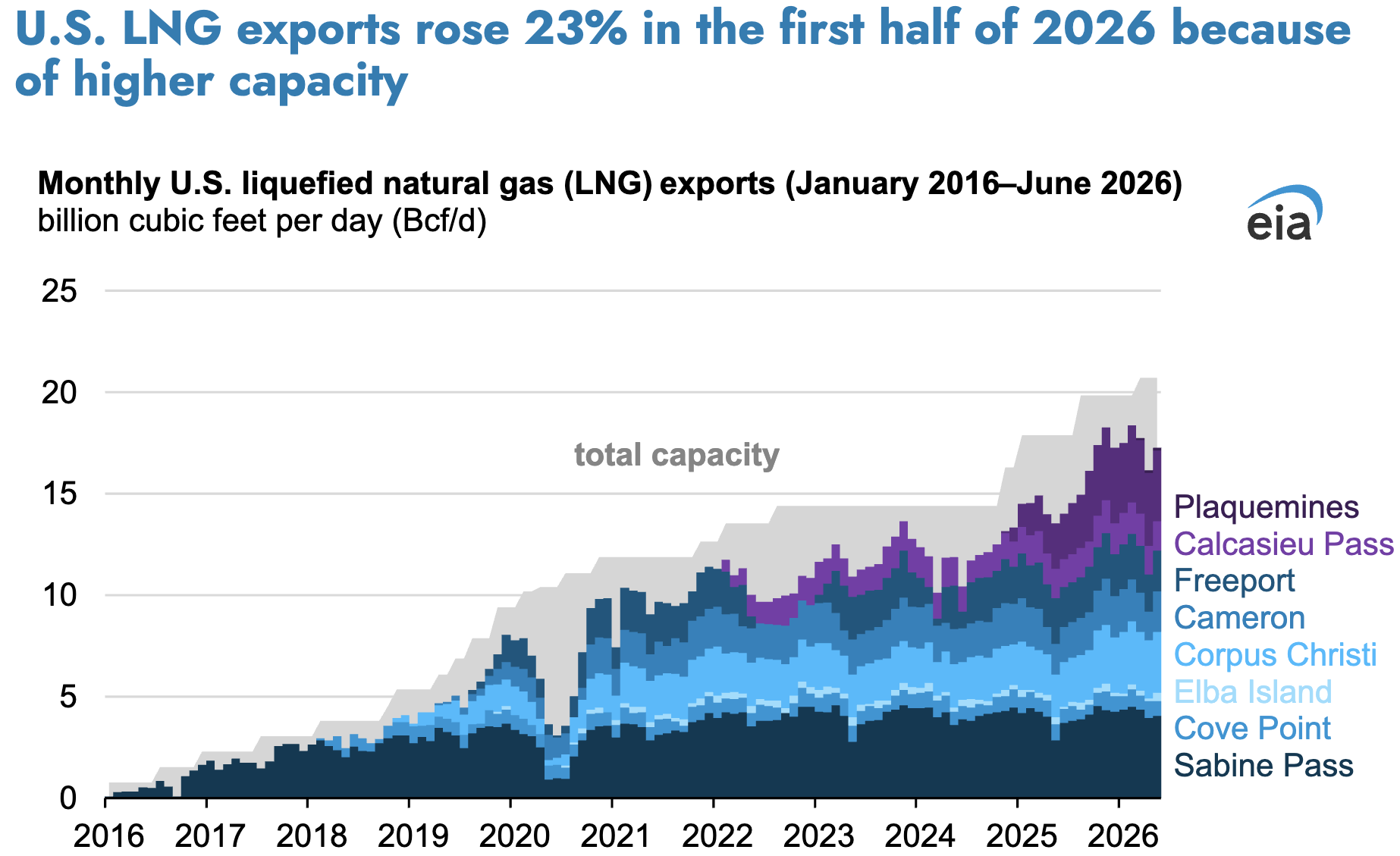
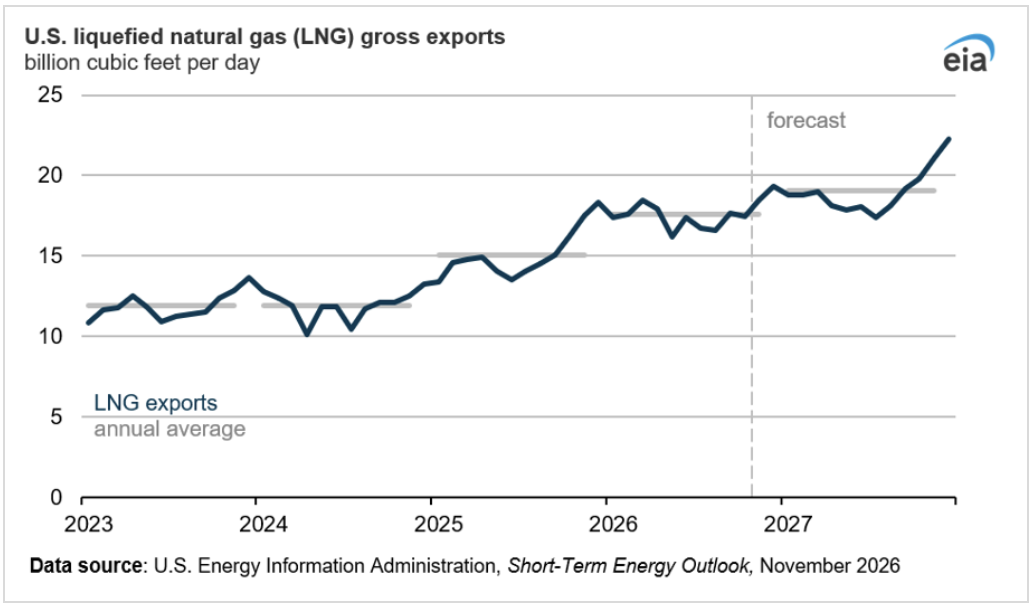
The Energy Information Administration (EIA) in its November Short-Term Energy Outlook expects LNG exports to average 17.6 billion cubic feet per day in 2026 and 19.0 billion cubic feet per day in 2027, up from 15.1 billion cubic feet in 2025, as new export capacity ramps up. The seventh and final train of the Corpus Christi Stage 3 export facility (1.5 billion cubic feet per day nominal capacity) reached substantial completion in late August. Golden Pass LNG has reported a sustained increase in feed gas demand in recent weeks following months of slower-than-expected exports from Train 1 since its April 2026 startup. U.S. LNG exports also increased in October as Cove Point LNG (0.8 billion cubic feet per day nominal capacity) concluded planned maintenance on October 12.
U.S. Natural Gas Production
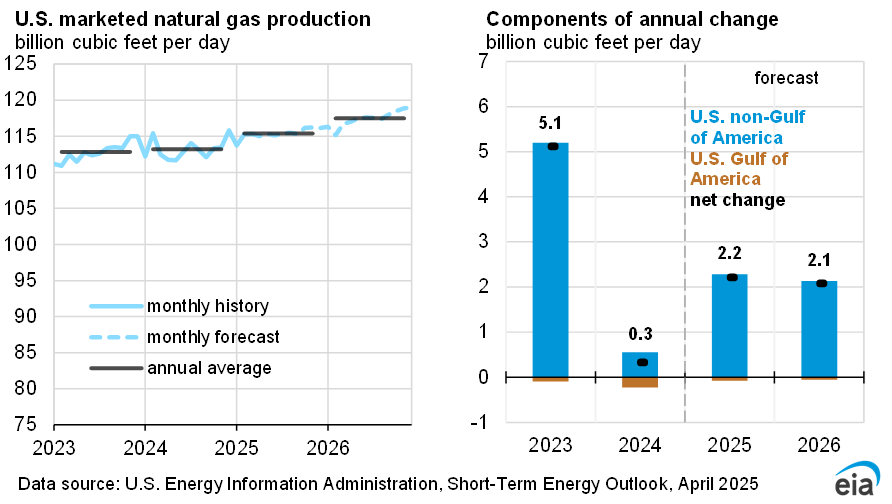
EIA expects that natural gas production will increase to 124.4 billion cubic feet per day in 2026 from 118.4 billion cubic feet per day in 2025, an increase of 5%. It expects a further 4% increase in 2027, when production is expected to rise by 5 billion cubic feet per day from 2026 levels. Gains come primarily from the lower 48 gas fields. Production growth outpaces increasing demand from domestic sources and exports, leaving U.S. natural gas inventories about 3% above 2025 levels on average.
U.S. Propane Exports
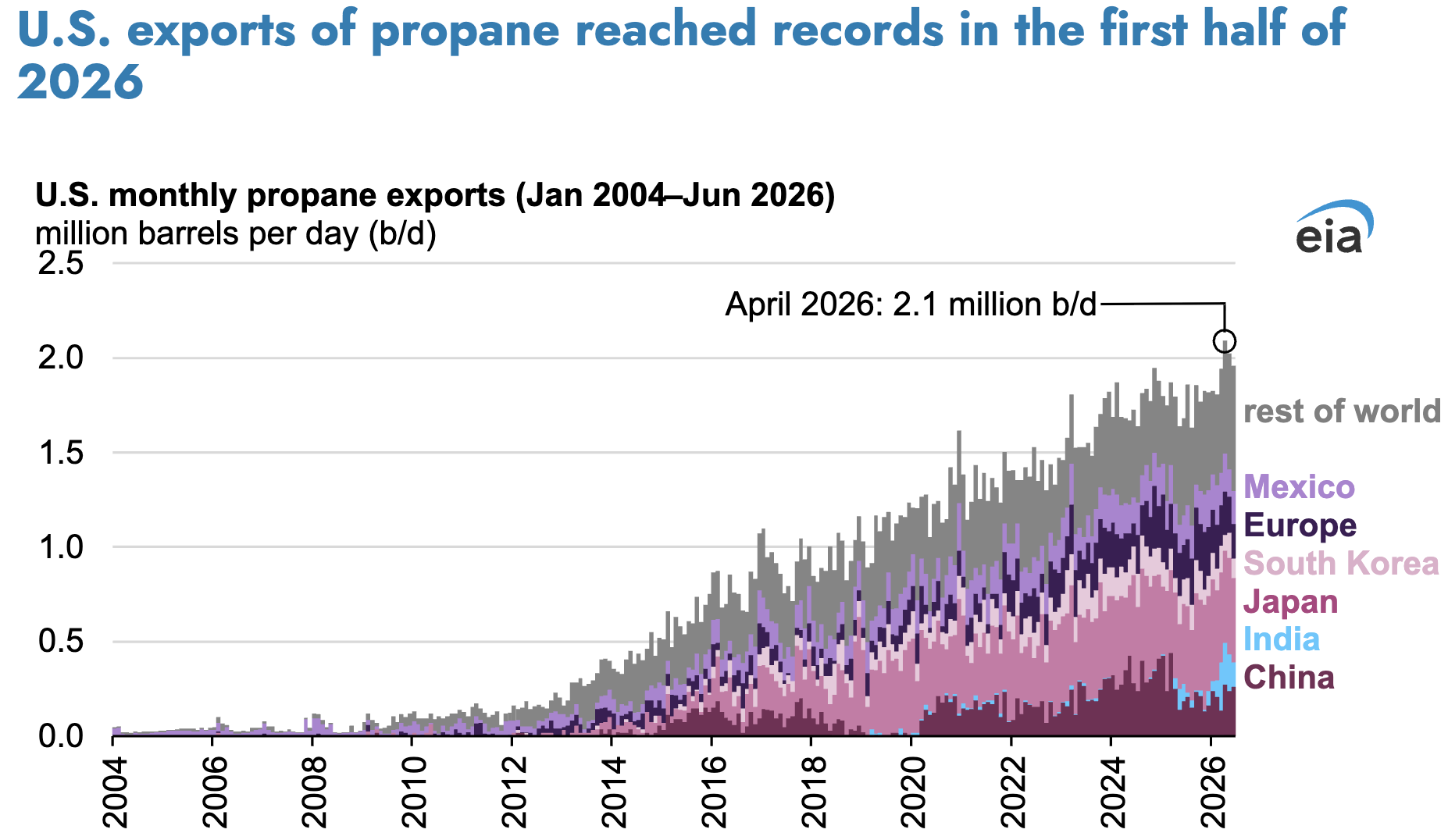
U.S. propane exports increased to 2 million barrels per day in the first half of 2026, up 11% from the same period in 2025. Higher U.S. propane production and shifting trade flows increased exports to India and other South Asian countries. Total propane exports have remained well above the five-year average. Over the past decade, U.S. propane production has grown significantly as natural gas output has increased, since propane is generated during both natural gas processing and crude oil refining. This rise in domestic supply has made U.S. propane prices more competitive with Asian markets, encouraging higher export volumes. Propane is consumed in the residential and commercial sectors for space heating and as a petrochemical feedstock to produce propylene and ethylene, key feedstocks in plastic production. An expansion project by Enterprise, expected to be completed this year at the Houston Ship Channel and Nederland terminals, will increase capacity by another 300,000 barrels per day.
U.S. Oil Production
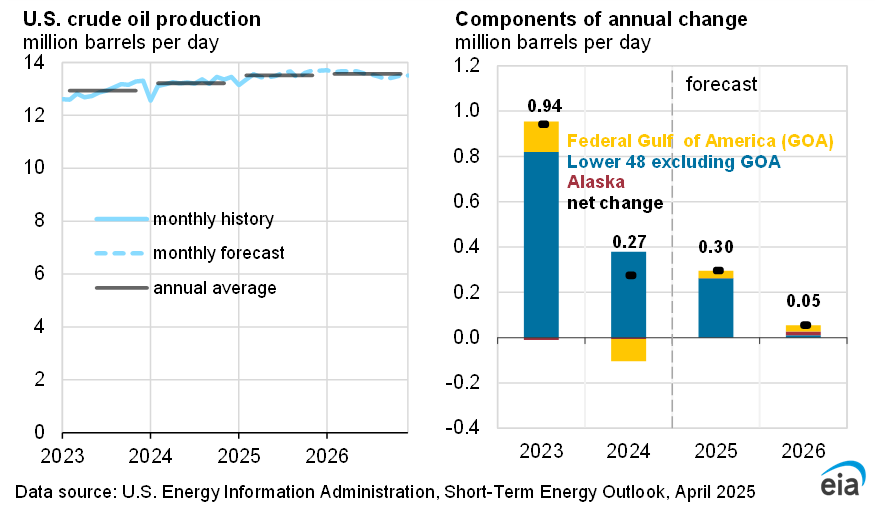
EIA expects U.S. crude oil production to average 13.9 million barrels per day in 2026, surpassing the 2025 record of 13.7 million barrels per day, according to its November Short-Term Energy Outlook (STEO). In the first half of 2026, crude oil production averaged 13.7 million barrels per day, up 2% (0.3 million barrels per day) from the same period in 2025. Most of this expansion is concentrated in the Permian region in Texas and New Mexico and the Federal Gulf of America.
Conclusion
The Russian invasion of Ukraine and the conflict in Iran have increased U.S. exports of crude oil, LNG, and refined products, as the United States is seen as a secure, reliable producer and exporter of these fuels. Countries in both Europe and Asia are major importing countries that have had to purchase cargoes from the United States instead of Russia and the Middle East due to sanctions on Russia and Iran and the U.S. blockade of Iranian ports. The new trade flow patterns have the United States accounting for more than 30% of global LNG gas trade, up from about 5% in 2018, and 10% to 15% of crude oil trade, about triple from its earlier 3% to 5% range. The United States is the world’s largest producer of oil and natural gas, and its flexible export portfolio covers everything from crude oil and LNG to natural gas liquids, refined fuels, and petroleum coke. Because U.S. exports often require longer transit times and higher shipping costs than supplies from the Gulf region, future gains in trade flows may depend on rising global consumption, competitive pricing, and the ability to attract new customers. The U.S. industry’s resourcefulness and its track record of shifting from a major importer to a major energy exporter, however, make continued success a likely bet.

