

Key Takeaways
President Trump’s Department of Transportation announced a rule to reset Corporate Average Fuel Economy standards, which the Biden administration had raised to over 50 miles per gallon — a level most gas vehicles would not be able to meet.
The Biden regulation would have forced consumers to buy electric vehicles rather than a vehicle that best meets their needs.
The new recommended standard requires 34.5 miles per gallon on average by 2031, down from Biden’s 50.4 miles per gallon.
The change is expected to reduce average vehicle costs by $930 and save Americans $109 billion over five years by making vehicles more affordable.
With Trump’s reset, automakers will no longer be forced to sell electric vehicles at a loss and raise prices on gasoline vehicles to make up the difference.
President Trump has taken other steps to make it easier to sell gas-powered vehicles, including rescinding EV tax credits and barring California from banning the sale of traditional gas-powered vehicles after 2035.
President Donald Trump proposed slashing Corporate Average Fuel Economy (CAFE) standards that former President Joe Biden finalized last year, in a move that automakers were looking for and which allows consumers to choose the best type of vehicle that fits their needs. Biden’s fuel economy standards were designed to incentivize more electric vehicle (EV) purchases, making it difficult for gasoline cars to meet the onerous standards. With the change, automakers will no longer be forced to sell EVs at a loss and raise prices on gasoline vehicles to make up the difference. Trump has taken other steps to allow consumers the ability to choose the right vehicle for them, including rescinding EV tax credits and rejecting California’s request for a waiver from federal law to ban the sale of gas-powered vehicles after 2035.
According to Reuters, the new recommended standard would significantly reduce the fuel economy requirements from model years 2022 to 2031, requiring 34.5 miles per gallon on average by 2031, down from 50.4 miles per gallon. The National Highway Traffic Safety Administration (NHTSA) is proposing to revise the 2022 fuel economy standards and then raise them between 0.25% and 0.5% annually through 2031. In 2022, the Biden administration increased fuel efficiency by 8% annually for model years 2024-2025 and 10% for 2026. U.S. dealers and others said the new standards are more in line with the vehicles customers want to buy rather than the more costly vehicles automakers have been pushed to produce due to regulations.
The change is expected to reduce average vehicle costs by $930 and save Americans $109 billion over five years. In October, Kelley Blue Book indicated the average price of a new car in the United States topped $50,000 for the first time, up 3.6% year-over-year. Signed into law in 1975, the CAFE standards regulate how far vehicles must travel on a gallon of fuel. Reducing the fuel economy requirements is estimated to increase fuel consumption by around 100 billion gallons through 2050.
As reported by Reuters, automakers are expected to save $35 billion through 2031, including $8.7 billion for GM and more than $5 billion for Ford and Stellantis. Ford CEO Jim Farley said the company would invest more in affordable vehicles. “Today is a victory for common sense and affordability… We believe that people should be able to make a choice.” According to GM CEO Mary Barra, before Congress blocked California’s zero-emission vehicle rules in June, the auto sector was facing requirements in some states that 35% of new vehicles sold in 2026 must be electric. “We were going to have to start shutting down plants because we weren’t going to be able to build and sell those vehicles,” Barra said. She, however, reaffirmed the carmaker’s commitment to electric vehicles.
Reuters adds that the proposal is also seeking to make changes to the credit trading program, including the elimination of credit trading among automakers in 2028, and ending some credits for fuel-saving features. According to NHTSA, credit trading was a “windfall for EV-exclusive manufacturers that sell credits to other non-EV manufacturers.” Ending credit trading could hurt EV manufacturers such as Tesla and Rivian, which have sold credits to companies that make gas-powered vehicles and cannot meet the standards. Earlier this year, Trump signed legislation that ended fuel economy penalties for automakers, and NHTSA said they faced no fines dating back to the 2022 model year. The increase in vehicle emissions from NHTSA’s proposal in 2035 would be the equivalent of annual emissions from 7.7 million vehicles over the Biden proposal.
Trump’s Prior Actions
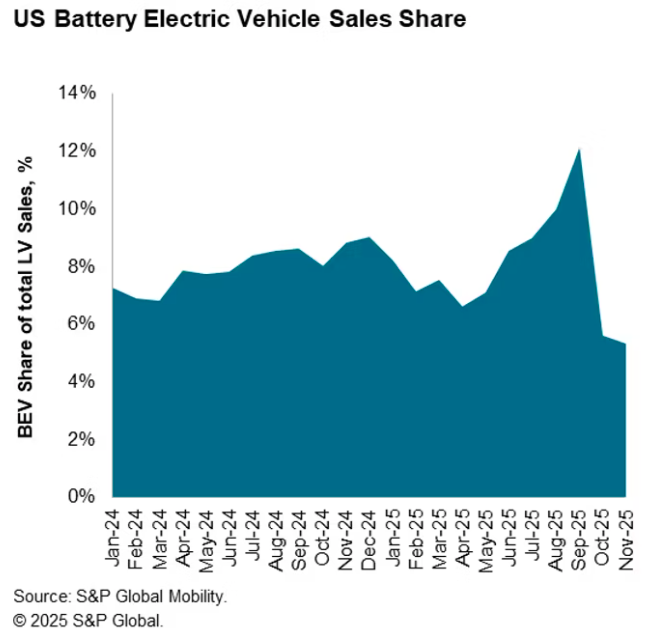
Trump’s One Big Beautiful Bill Act repealed financial penalties for automakers that do not meet fuel efficiency requirements and ended the EV tax credit on September 30. Sales of new electric vehicles have plunged since then. In November, electric vehicles accounted for 5.3% of U.S. new-car and light-truck sales — less than half the record high in September. Ford’s November unit sales of its Mustang Mach-E were down 49% compared to the same month in 2024. Hyundai’s Ioniq 5 was down 59%. The president also signed a law to block California from enforcing a ban on new gas-powered car sales — a waiver that the state received under the Biden administration that allowed it to set its own rule and that other states could follow.
Analysis
Under the Obama and Biden administrations, CAFE transformed from a fuel efficiency measure to a de facto EV mandate, requiring automakers to replace their profitable, affordable vehicles with EVs. The Trump administration’s changes will help bring it back in line with its original intent; however, CAFE’s vehicle market distortions will continue to burden consumers and automakers with higher prices and fewer options until it is fully repealed. As IER’s Tom Pyle has argued, “President Trump and the Republicans in Congress must push to completely eliminate fuel economy standards once and for all. It’s time to repeal CAFE and let the market determine the future of the automobile industry.”
For inquiries, please contact [email protected].

