

Key Takeaways
Europeans are paying far higher electricity prices than Americans due to their rush to transition to renewable energy, generous subsidization of wind and solar, climate policies taxing fossil fuels, and the premature retirement of coal plants.
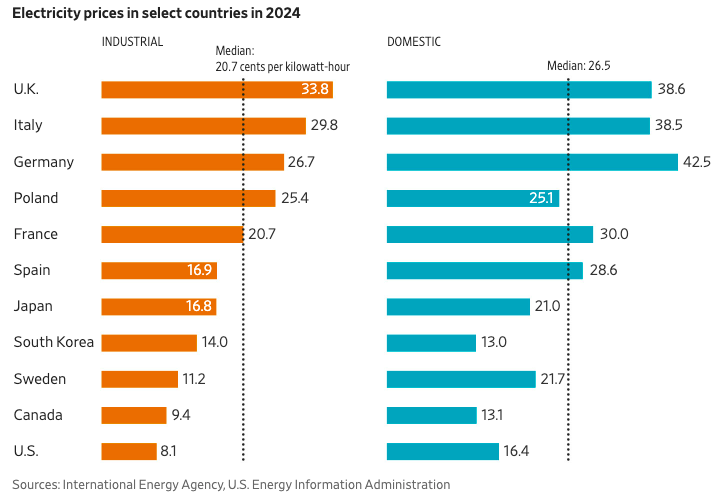
Europe’s electricity prices are two to four times higher than those of the United States, with the U.K.’s industrial electricity price — the highest in Europe — 4.2 times higher than the U.S. industrial electricity price and Germany’s residential electricity price — also the highest in Europe — 2.6 times the U.S. residential electricity price.
In the U.K., the cost of procuring and delivering electricity accounts for just over half of domestic electricity bills, with the rest made up of levies and carbon taxes, including subsidies to pay for renewables and grid upgrades.
The high prices are causing economic damage to Europe, causing companies to flee and making Europe uncompetitive in the AI race.
Electricity prices in the United States are also increasing as President Biden enacted European-type climate policies that President Trump is doing his best to undo.
Americans should be glad that President Trump has stopped the disastrous climate policies of the Biden administration. Biden was following Europe’s footsteps and driving up electricity prices. Europe’s electricity prices are two to four times higher than those of the United States, with the U.K.’s industrial electricity price — the highest in Europe — 4.2 times higher than the U.S. industrial electricity price and Germany’s residential electricity price — also the highest in Europe — 2.6 times the U.S. residential electricity price. Business executives and some economists say the majority of the increase is due to the shift to renewables, largely wind and solar power. Intermittent renewable energy cannot operate 24/7 and, therefore, requires redundant back-up power or expensive battery storage, adding to system costs. The units also need to be located where wind and solar resources are strong, requiring additional costly infrastructure.
To make matters worse, governments provide these technologies with generous subsidies that further obscure their true cost. The costs for the fixed feed-in tariff for new solar power, for example, often run for 20 years and add up to billions. While renewables generate more than 60% of Germany’s electricity, including 73 gigawatts of wind and 112 gigawatts of solar, additional subsidization would bring on more wind turbines or solar facilities that would add costs with barely any benefit. The Wall Street Journal reports that Goldman Sachs Research expects Europe will have to invest up to $3.48 trillion in power generation and infrastructure over the coming 10 years — roughly double what European countries spent in the past decade. Advocates promised that renewables would eventually bring down electricity bills, but one consulting firm estimates a “clean power” system in the U.K. would only start saving bill payers money beginning in 2044, and a similar time frame in Germany.
As the Journal explains, Europe’s power prices have climbed sharply as governments pushed to phase out fossil fuels, relying more on solar, wind, and biomass while taxing carbon heavily and closing conventional plants ahead of schedule. In the U.K., the cost of generating and transporting electricity now represents just over half of a household bill; the rest comes from levies and carbon charges that fund renewable-energy subsidies and grid modernization. Those surcharges have risen faster than wholesale energy prices over the past decade.
The strain is reshaping consumer behavior. Surveys show that about half of British households expect to ration energy use this winter. In London, one office administrator said she can afford to heat her home for only three hours a day and keeps her bedroom unheated. Energy executives warned lawmakers recently that bills could rise another 20% in real terms by the end of the decade — even if natural-gas prices continue to ease — because “noncommodity” costs such as new grid investments are set to keep climbing.
According to the Wall Street Journal, Europe’s steep energy costs are increasingly weighing on its industrial base, prompting companies to scale back operations or leave altogether. British chemical maker Ineos said it will shut two plants in western Germany, citing untenable energy prices. ExxonMobil announced this week that it plans to close a chemical facility in Scotland and warned it may withdraw from Europe’s chemicals sector entirely, arguing that the region’s climate policies have eroded its ability to compete.
As the Journal explains, Europe’s soaring power costs are also undermining its ability to compete in the global race to build out artificial-intelligence (AI) infrastructure. In Ireland, the national grid operator has imposed a moratorium on new data-center connections until 2028, after existing facilities consumed more than one-fifth of the country’s electricity last year. The squeeze is evident elsewhere. In Frankfurt — Germany’s primary internet hub — Jerome Evans, the chief executive of a German data-center operator, sought to expand his two facilities. But the local power plant told him he would have to wait until 2035 for the additional electricity needed to support the upgrade, a delay that risks pushing investment to lower-cost markets such as China.
The U.S. Situation
The United States still gets about 60% of its electricity generation from fossil fuels, despite wind and solar energy now providing a combined 16%. The transition began during the Obama administration, as coal plants began to be prematurely retired due to generous subsidies and state mandates for renewable energy. The coal retirements continued until this year, with President Trump and Energy Secretary Chris Wright trying to stop the purge. Utilities have continued to build natural gas plants, but in far fewer quantities than renewable plants. AI data centers and rising electricity demand due to Biden administration policies are causing more utilities to turn toward natural gas as a reliable generating technology. Despite the changes, President Biden’s climate policies are still pushing electricity prices higher as it takes time to transition the system back, given the current momentum toward renewables.
Analysis
Fueling the energy needs of the future without causing rates to skyrocket requires reliable electricity from baseload generation. Europe has moved in the opposite direction by subsidizing renewable energy and enacting carbon taxes, making it less competitive for technology and manufacturing companies. It’s no surprise that the U.S. has more than three times the number of data centers (~5,000 vs. 1,200) than Europe and that industrial production in Europe declined in August.
For inquiries, please contact [email protected].

