

California Gasoline Prices
As the conflict in Iran continues to disrupt the global oil market, California’s gas prices rose another 10 cents overnight. According to AAA, on March 6, California’s average gasoline price was $4.905 per gallon, while the nation’s average was $3.320, making it almost 50% higher. While the situation in Iran is largely to blame for the recent increase, California’s policies are a contributing factor and are making the impacts from the conflict on consumers much worse.
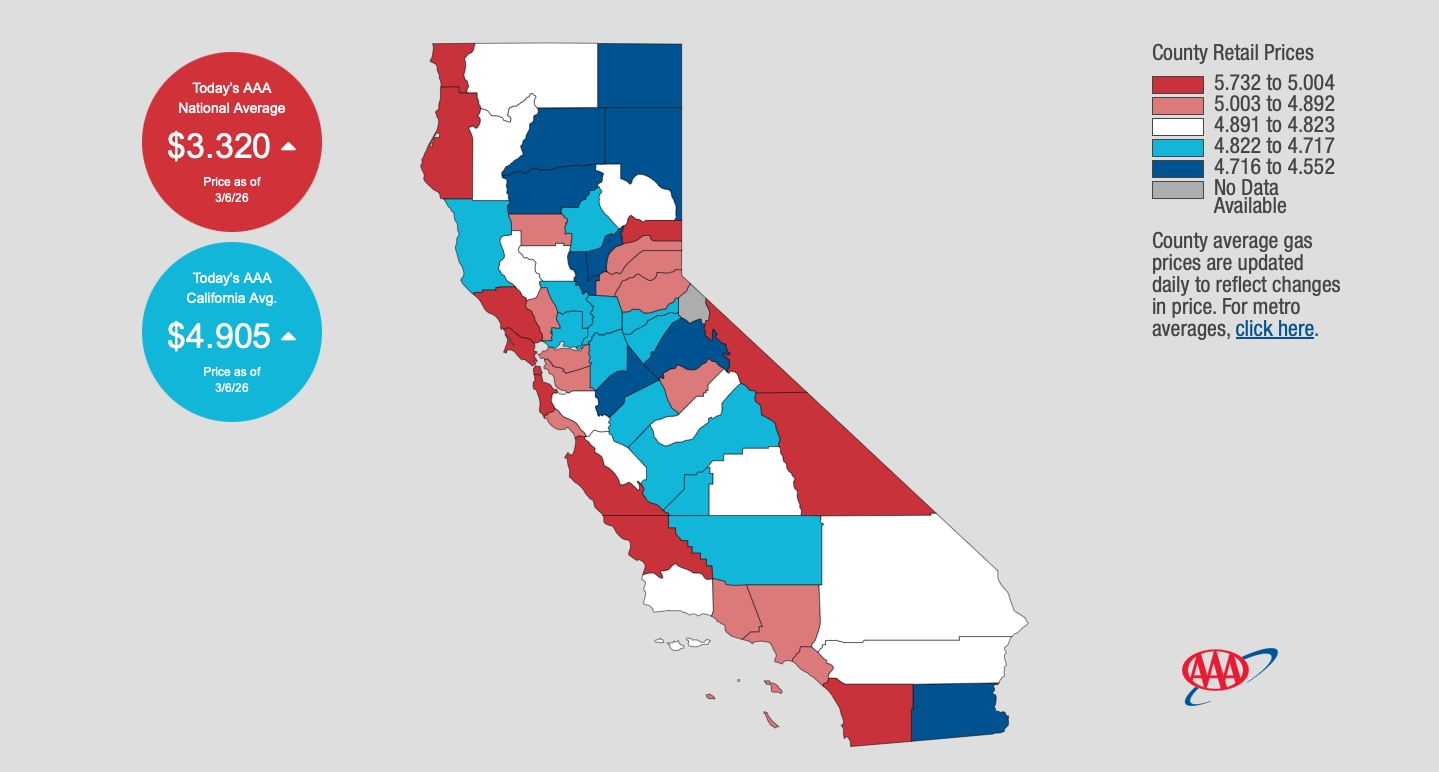
Source: https://gasprices.aaa.com/?state=CA
By blaming California’s high gas prices solely on the conflict in Iran, Governor Gavin Newsom ignores his own detrimental policies, which have made the state’s gasoline prices over 50% higher than the rest of the nation. Californians should note that the average price of regular gas in California rose by 38 cents from January to February 2026, before the strikes in Iran.
California’s onerous regulations have shut down refineries and forced California to rely on imports and deliveries from the U.S. Gulf that must travel to the Bahamas before reaching California shores. To get gasoline from Gulf refineries to California, it is first unloaded in the Bahamas because of the Jones Act — a 1920 federal law that mandates that goods shipped between U.S. ports must travel on U.S.-built, owned, and operated vessels, resulting in higher shipping costs. Because of the state’s boutique fuel requirements, not many out-of-state refineries produce California’s unique gasoline blends, and little pipeline infrastructure exists to bring supplies from other states.
IER’s Alex Stevens discusses California’s gas prices on KPIX CBS News – Bay Area.
Since Newsom became Governor, California’s oil production has declined, and several refineries have closed. Most recently, two major refineries, the Phillips 66 refinery in Bakersfield and the Valero facility in Benicia, have already shut down or are in the process of shutting down due to Newsom’s radical environmental agenda, including a refinery price-cap law he signed in 2023. Newsom accuses oil companies of price-gouging when they just want to supply their products and get adequately compensated for them.
Currently, the few remaining California refineries are undergoing maintenance and switching to the state’s summer-blend gasoline, which brings on a seasonal price increase. Some state lawmakers have proposed a temporary pause in California’s gas tax to ease pump price increases. Higher prices result from numerous factors, including refinery maintenance, reduced output, and higher production costs for summer-blend fuel. Summer-blend gasoline is formulated with a lower Reid Vapor Pressure (RVP) to reduce evaporation at higher temperatures, a requirement to combat air pollution in California’s summer months. Other states begin making the switch to summer-blend gasoline closer to May 1, while California refineries start much earlier because some areas require summer-blend fuel on April 1.
Background
California had as many as 42 refineries 40 years ago, and since 2000, its operational refineries dropped from 23 to 12 at the end of 2025. Phillips 66 shuttered its Los Angeles refinery in October, and Valero will shutter its Northern California refinery this spring, bringing the state’s refinery count to 11. California’s environmental policies make it difficult for refineries to operate and make a profit, particularly as California Governor Newsom touts price gouging by oil companies as the reason for the state’s high gasoline prices, which are about $1.50 per gallon higher than the national average price, as indicated above.
California’s gas prices are the highest in the nation because it has the highest state gasoline tax at $0.709 per gallon, a cap-and-trade program that taxes fossil fuels, a low-carbon fuel program, underground gas storage fees, and a state and local sales tax. Higher gas prices could be Newsom’s goal because he wants Californians to buy electric vehicles, regardless of their cost and the state’s power costs.
Until the early 1990s, California was the nation’s third-largest oil producer. While it has oil resources and is now the eighth-largest oil producer among states, its oil production has dropped significantly due to state policies. California’s oil output dropped from 760,000 barrels per day in 2000 to 250,000 barrels per day in 2025. The state imports 63% of its oil from foreign countries, despite having at least 1.7 billion barrels of proven reserves.
California made some concessions to its onerous environmental rules after talks with state officials failed to keep Valero’s refinery from shuttering. The California Energy Commission delayed a rulemaking on a refiner profit cap for five years, which was shorter than the 10-year delay the oil industry recommended, seeking a strong market signal to encourage refinery investment. And last year, Newsom signed legislation that expedited permitting of some onshore oil and gas wells, allowing some new wells to bypass extensive state environmental reviews. However, the impacts are marginal and do not affect the refinery problems.
Analysis
California Governor Newsom is blaming President Trump for rising gasoline prices, but his state is hit hardest by his own policies. The state has lost about a quarter of its refinery capacity since Newsom became Governor in 2019, as the governor accuses oil companies of price-gouging.
The state now imports 63% of its oil from foreign countries despite having at least 1.7 billion barrels of proven reserves that are difficult to tap. It has the highest state gasoline tax in the nation at $0.709 per gallon, a cap-and-trade program that taxes fossil fuels, a low-carbon fuel program, fees for underground gas storage, and a state and local sales tax that also applies to gasoline prices. Newsom’s environmental programs aim to encourage Californians to purchase electric vehicles, and high gasoline prices help with that.
For inquiries, please contact astevens@ierdc.org.

