

Key Takeaways
The United States has increased sanctions on shipments of Iranian oil, with the U.S. military expanding enforcement globally.
The United States has begun boarding and seizing vessels transporting Iranian oil and tracking ships beyond the initial blockade zone.
On April 24, the United States sanctioned a Chinese refinery, one of Iran’s largest customers of oil and petroleum products, and 40 shipping firms and vessels — part of Iran’s “shadow fleet.”
To help with domestic supply, President Trump is extending the Jones Act waiver for 90 days, allowing foreign ships to transport U.S. goods between U.S. ports.
The Epoch Times reports that, on April 24, the United States sanctioned a Chinese refinery and 40 shipping firms and vessels found to be providing a lifeline to the Iranian oil economy. The Chinese company is Hengli Petrochemical (Dalian) Refinery Co., the second-largest independent oil refinery in China and one of Iran’s largest customers for oil and petroleum products, having purchased products worth billions of dollars. The Trump administration is cutting off key revenue sources for Iran that include oil shipments from its ports, which the United States has blocked. At least 34 vessels have been turned back since the United States imposed its blockade on April 13. The U.S. blockade is global, with U.S. forces having seized two Iranian “dark fleet” vessels in the week of April 20 that departed Iranian ports before the blockade took effect.
The Hengli refinery has purchased oil shipments from Iran’s armed forces since 2023, resulting in hundreds of millions of dollars for the Iranian military. The refinery has the capacity to process 400,000 barrels per day. China’s “teapot refineries,” small- to medium-sized refineries, are significant purchasers of Iranian oil exports, with China accounting for about 90% of those exports. Iran uses a shadow fleet of vessels, of which many are oil tankers from Hong Kong. A Marshall Islands-flagged tanker owned by a China-based shipping company has transported millions of barrels of Iranian oil over the past few months.
The U.S. sanctions impose penalties on anyone contributing funds, goods, or services to Iran. The April 24 sanctions add to the more than 1,000 Iran-related people and entities already on the Treasury Department’s Office of Foreign Assets Control sanction list. According to U.S. Treasury Secretary Scott Bessent, his agency will continue to “constrict the network of vessels, intermediaries, and buyers Iran relies on to move its oil to global market” and “[a]ny person or vessel facilitating these flows—through covert trade and finance—risks exposure to U.S. sanctions.”
Tommy Pigott, spokesperson for the State Department, described the sanctions as part of the administration’s “maximum pressure campaign” to “hold Tehran accountable for its regional aggression and threats to American interests.” He added that “[t]he administration remains focused on ensuring the Iranian regime cannot use illicit oil revenues to advance its malign agenda while the Iranian people continue to suffer from economic mismanagement and repression.”
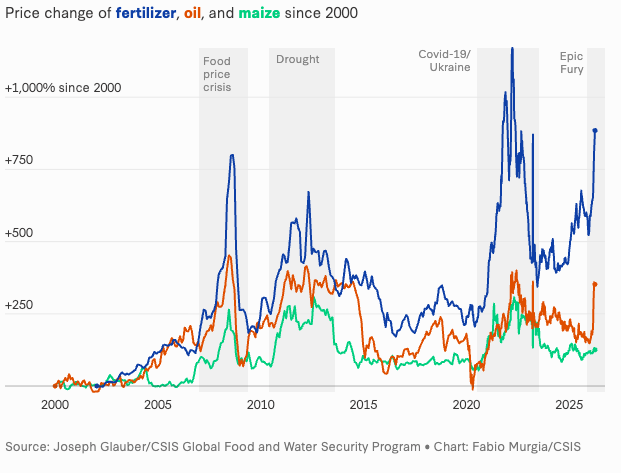
The war with Iran has resulted in about 13 million barrels per day of oil unavailable to global markets, as well as other disruptions in key commodities such as fertilizer. Just as planting season is starting in many countries, fertilizer prices have risen, as about a third of the global fertilizer trade transits through the Strait of Hormuz. Nitrogen‑intensive crops such as corn and wheat will be affected first, with higher feed costs eventually spilling over to other food products, including bread, poultry, and eggs. Fertilizer production is energy-intensive, relying heavily on natural gas as a feedstock, with energy making up as much as 70% of production costs. About 20% of the global natural gas trade has been affected by the closure of the strait.
In an effort to ease domestic supply pressures, on April 24, President Trump extended a waiver of the Jones Act for 90 days, allowing foreign-flagged vessels to transport fuel between U.S. ports. The 1920 law requires that ships carrying goods between U.S. ports be built, flagged, owned, and operated by Americans. So far, since President Trump first initiated the waiver of the Jones Act on March 18, only one non-U.S. ship has made the transit between U.S. ports. A Malta-flagged ship is transporting oil from Texas to a refinery in Pennsylvania. Phillips 66 is shipping oil from shale formations in North Dakota and Montana at a Phillips 66 terminal in Beaumont, Texas, onto the Malta-flagged Htm Warrior, delivering it to the Trainer refinery in Pennsylvania, owned by Delta Air Lines unit Monroe Energy. This was the first known occurrence of U.S. oil being shipped from the Gulf Coast to the Atlantic Coast since President Trump waived the Jones Act.
Analysis
The Jones Act has raised prices on American consumers since its inception. The waiver should help lower oil prices by allowing more ships to transfer oil where it’s in demand, increasing supply. Hopefully, the Trump administration and Congress will recognize that if waiving the Jones Act helps in a crisis, then it should be fully repealed. Clearly, its national security justifications have become obsolete if it needs to be repealed amid a war. As IER’s Caleb Jasso explained regarding the initial pause, “Today, supporters of the Jones Act argue that it is still vital for national security as it doesn’t place the U.S. in a vulnerable position of being reliant on foreign vessels, while opponents contest that it does nothing more than force the American people to rely on older vessels, increasing shipping costs, and limiting domestic transportation options… Suspending the Jones Act for a period of time will prove beneficial, as it would allow foreign vessels to transport oil, gasoline, coal, natural gas, and other products between American ports.”
For inquiries, please contact wrampe@ierdc.org.

