

Key Takeaways
EIA published the first edition of its new “Global Energy Security Data” report, launched in part to assess how the war in Iran has disrupted global energy supplies and reshaped oil market flows.
EIA plans to publish it quarterly to reflect trends and changes in energy flows.
During the first quarter of 2026, the Strait of Hormuz lost about 6 million barrels per day of oil and petroleum products that had transited through it in the previous quarter, down almost 30%.
Around three-fourths of that amount was in oil shipments, with the rest in petroleum liquids.
The Energy Information Administration (EIA) has published a new report, the Global Energy Security Data report, that tracks global strategic petroleum reserves and energy flows through major shipping chokepoints, including the Strait of Hormuz. During the first quarter of 2026, crude oil and petroleum liquids that moved through the Strait of Hormuz fell almost 30% year over year to 14.6 million barrels per day in the first quarter due to disruptions from the conflict with Iran. During that quarter, flows of crude oil and petroleum liquids through the Strait of Hormuz fell by nearly six million barrels per day, down from 20.4 million barrels per day a year earlier and 20.7 million barrels per day in the fourth quarter of 2025. The Strait of Hormuz has been effectively closed by Iran since the beginning of the conflict, choking off a vital route for about 20% of the world’s seaborne oil and LNG. The Strait of Hormuz is located between Oman and Iran and connects the Persian Gulf with the Gulf of Oman and the Arabian Sea.
EIA also broke down the 14.6 million barrels per day that transited the Strait of Hormuz into crude oil and petroleum products, with crude oil accounting for 10.7 million barrels per day (almost three-quarters) and petroleum liquids for 3.9 million barrels per day.
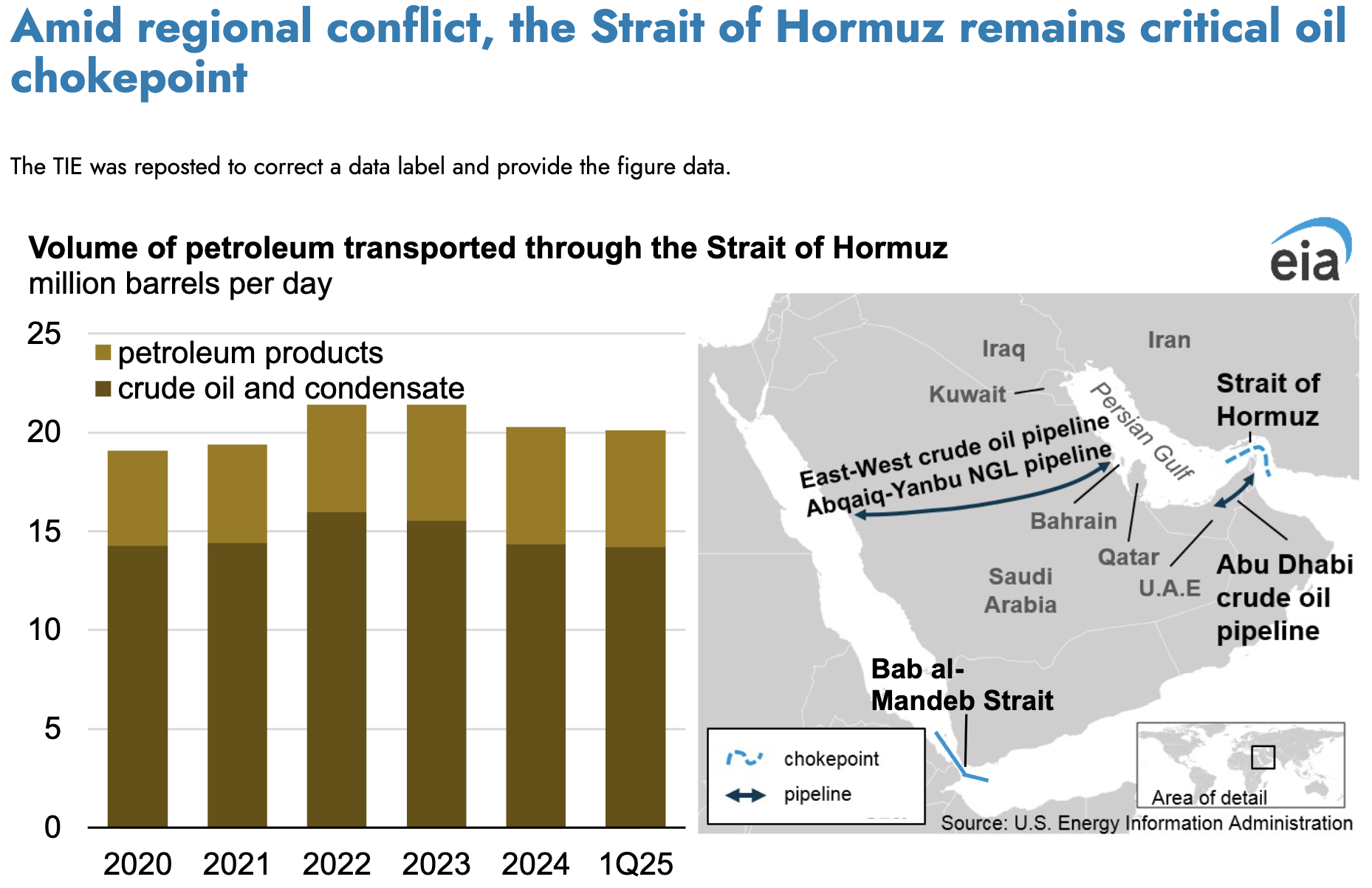
Buyers have had to replace Middle East oil and petroleum liquids with shipments from other parts of the world and use alternative shipping routes. Volumes in the first quarter rose for crude oil and petroleum liquids transported through the Panama Canal and the Bab El-Mandeb Strait located between the southwestern tip of the Arabian Peninsula (Yemen) and the Horn of Africa (Djibouti and Eritrea). It connects the Red Sea to the Gulf of Aden and the Indian Ocean, serving as a vital link for global trade and energy shipping.
Strategic chokepoints, such as the Strait of Hormuz, are narrow waterways along major international shipping routes that play a vital role in global energy security. Any disruption that prevents oil from passing through one of these key passages, even for a short time, can lead to major supply interruptions, higher transportation expenses, and rising global energy prices. Some chokepoints can be circumvented by using alternative routes, which often add significantly to transit time. In the case of the Strait of Hormuz, there are two pipelines that can avoid the Strait of Hormuz but are limited by their pipeline capacity. Saudi Arabia’s East-West pipeline transports oil to ports on the Red Sea and has a current capacity of 7 million barrels per day. The United Arab Emirates’ Abu Dhabi Crude Oil Pipeline, also known as the Habshan-Fujairah pipeline, can carry up to 1.8 million barrels per day. The UAE plans to double that capacity by next year by constructing a new pipeline.
The decline of flows through the strait has resulted in much higher Brent crude oil prices, rising more than 45% since the start of the conflict. In the United States, average retail gasoline prices have risen above $4.50 a gallon, but are still below 2022 levels when Russia invaded Ukraine during the Biden administration.
The EIA report also provides Strategic Oil Inventories for select countries. At the end of the first quarter of 2026, the United States had 413 million barrels of strategic oil reserves, substantially less than the 714 million barrels of capacity that the caverns hold due to President Biden releasing the reserves to lower gas prices before the 2022 mid-term elections and not replacing them. China had 1,541 million barrels of oil at the end of the first quarter 2026, more than the 1,397 million barrels it had at the end of the fourth quarter 2025, which shows that China is well prepared for emergencies. However, China relies on oil imports for most of its supply and is heavily dependent on the Strait of Malacca for the transit of much of it.
Analysis
This report is the first edition of the EIA’s new Global Energy Security Data report, launched in part to assess how the war in Iran has disrupted global energy supplies and reshaped flows in oil markets. During the first quarter of 2026, the Strait of Hormuz lost about 6 million barrels per day of oil and petroleum products that had transited through it in the previous quarter, down almost 30%, with about three-fourths of that amount in oil shipments and the rest in petroleum liquids. EIA also estimated the strategic oil inventories for select countries at the end of the first quarter of 2026. China’s strategic oil inventories were 3.7 times those of the United States at 1,541 million barrels, making China well prepared for emergencies affecting oil supplies.

