

Key Takeaways
Europe has been banking on wind and solar energy to run its power sector and meet its climate goals, generating 36% of its electricity from renewables in 2025.
It has raised energy prices to two to three times what Americans pay, as wind and solar power require a separate backup system to keep the lights on when the weather is still and/or cloudy.
That means customers are paying for a duplicate energy system that could do the job on its own if not for Europe’s climate laws, which are driving them to use renewable energy sources.
While storage batteries can also provide backup, they are expensive, draw power from generators only when excess power is available, have limited storage capacity, and take up space.
Europeans need to heed Energy Secretary Chris Wright, who told Western European nations to quit celebrating power plant closures and start expanding their energy production.
If Europe continues down the path of closing firm, dependable power and replacing it with wind, solar, and storage batteries, costs to consumers will skyrocket.
It will also hasten Europe’s already underway deindustrialization, as industries will have no choice but to leave for places with more affordable electricity.
In some countries, Europeans pay two to three times more for electricity than Americans because of their insistence on “green energy,” namely wind turbines and solar panels that do not produce power 24/7. When those technologies aren’t operating, a full backup system is needed to keep the lights on when customers demand it, raising total system costs. That means households and businesses pay for two electricity systems when they need only one that can run 24/7. Bjorn Lomborg points this out in his post on X and in the graph below, which depicts the high cost of electricity in European countries, particularly the UK and Germany. While green advocates argue that storage batteries can back up wind and solar units, they are very expensive, take up a great deal of space, rely on excess generated power when available, and can only provide power for a limited time. To have enough storage batteries to do the entire backup job would be cost- and space-prohibitive. Europeans need to wake up to these realities or face even higher prices and more energy poverty.
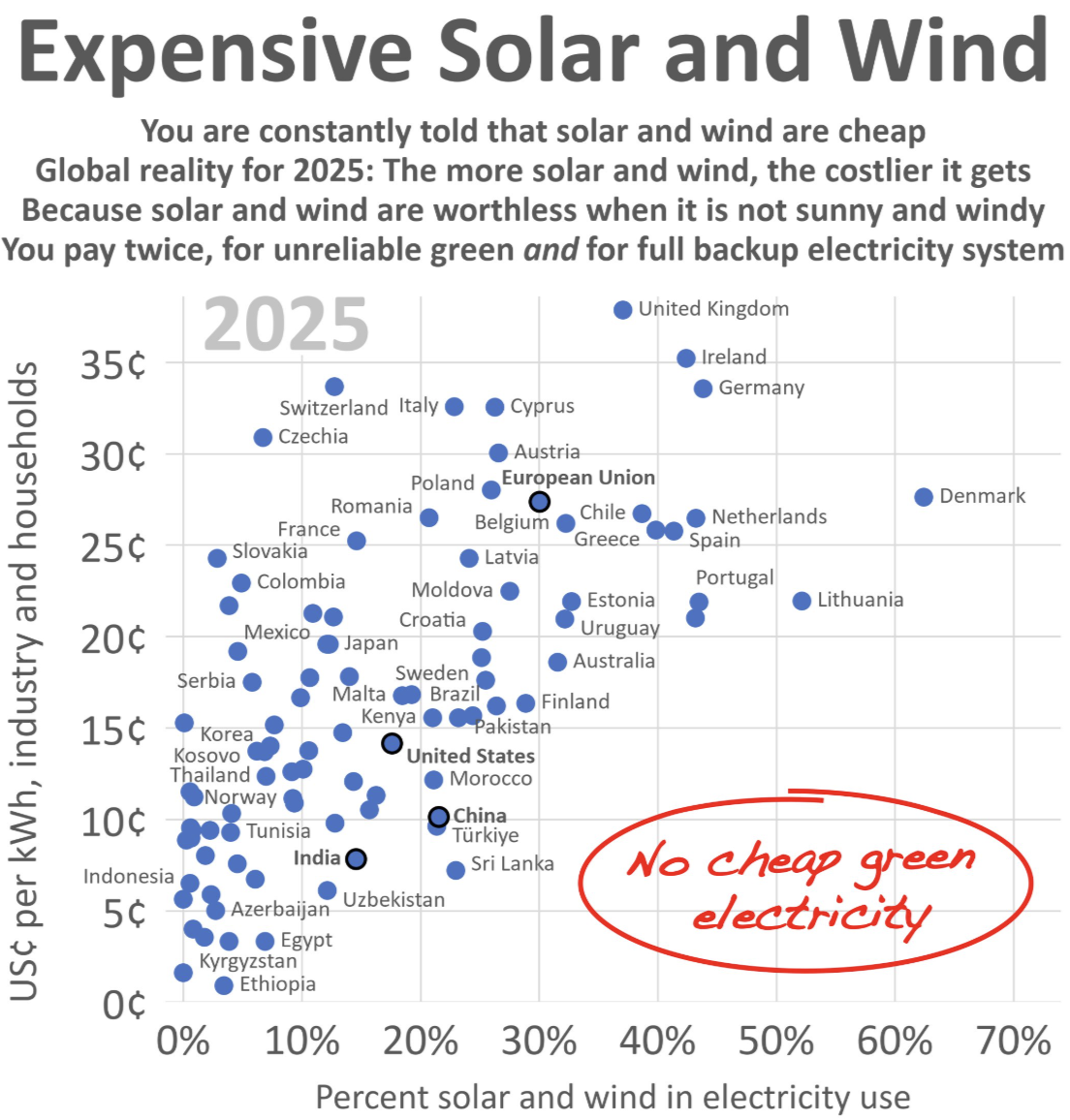
Further, wind and solar power do not function well in severe weather, or even calm weather that reduces wind or increases cloud cover. Recently, cloudy weather from a front affected wind and solar in some of Europe’s largest electricity markets, driving peak evening power prices to 2022 highs. Across the UK, Germany, and France, the top electricity markets in Europe, wind and solar power generation dropped, with wind speed slumps especially pronounced in Germany, the UK, Belgium, and the Netherlands. This meant electricity prices were set mainly by natural gas-fired plants amid historically low European gas storage levels. The Russian invasion of Ukraine and the conflict with Iran have made natural gas expensive for European buyers, as limited LNG supplies replace cheaper pipeline gas and many European nations refuse to explore for more natural gas. The European market faces this winter without Qatari supply, a ban on Russian LNG imports as of January 1, 2027, and the lowest gas storage levels ahead of winter.
Europe remains in a vulnerable gas supply position as LNG flows from the Strait of Hormuz are still way below pre-war levels and QatarEnergy has extended the force majeure on deliveries–in force since April 2026–until the end of December 2026, which drove European natural gas prices to the highest level since the autumn of 2022. EU gas storage sites were 70.5% full as of November 14, well below the five-year average for this time of the year, but those storage levels have started to fall as withdrawals have already begun in most EU countries.
Amid the gas storage shortage, Bloomberg indicates that Germany is preparing to bring back coal- and oil-fired power plants currently held in reserve in case of a natural gas emergency this winter. Germany normally keeps coal- and oil-fired units in reserve outside the regular electricity market and activates them when needed to stabilize the grid. Under the proposed rules, they would be kept fueled and ready to replace gas-fired generation if the government declares a gas shortage, freeing up natural gas for household and industry use. During the 2022 energy crisis, Germany used a similar approach, allowing reserve coal- and oil-fired power plants to return to the regular market to reduce gas consumption. The measure was in place over two winters and expired in March 2024. Under the latest proposal, coal and oil plants would be used only if the government formally declares an emergency. Plant operators would need to keep 30 days of coal and 10 days of oil on hand. The measure would end in March 2028.
Despite Europe’s shift to wind and solar power, fossil fuels (coal, natural gas, and oil) still supplied 57% of global electricity generation in 2025, while non-hydro renewables, mainly wind and solar, supplied 19%. EU’s share of fossil fuels in the generation market was lower at 28%, and wind and solar’s share was higher at 36% in 2025. Of course, when other energy sectors are considered, such as transportation and industry, renewables lose share as fossil fuels dominate the global market with 86% of total primary energy.
Speaking in Warsaw at the Partnership for Transatlantic Energy Cooperation conference, U.S. Energy Secretary Wright told Western European nations to quit celebrating power plant closures and start expanding their energy production. Recently, Britain allowed an offshore gas project to begin production—a project that was originally approved in 2022, before the government imposed a moratorium on new drilling in 2024. The project is expected to produce 6% of Britain’s domestic gas production at peak output, reducing the country’s reliance on imported liquefied natural gas. But fracking remains banned in the UK and in many EU countries such as Germany, France, and Spain.
Wright explained that Poland is a gateway for American LNG into the region, which benefits Polish energy security and its immediate neighbors. Poland has been vocal about the need to diversify its energy supply after Russia’s invasion of Ukraine in 2022. It has also been one of the most prolific signatories to long-term LNG agreements with U.S. suppliers. According to Polish Energy Minister Milosz Motyka, there can be no return to business with Russia. “Russia used energy sources like a weapon,” he said.
Conclusion
Europe is banking on wind and solar energy to run its power sector and meet its climate goals, with renewables generating 36% of its electricity in 2025. In doing so, it has raised energy prices to two to three times what Americans pay, as wind and solar power require a separate backup system to keep the lights on when the weather is still and cloudy. That means customers are paying for a duplicate energy system to be available, even though it could do the job by itself if not for climate laws. While storage batteries can also provide backup, they are expensive, draw power from generators only when excess power is available, have limited storage capacity, and take up space. Europeans need to heed Energy Secretary Wright, who told Western European nations to quit celebrating power plant closures and start expanding their energy production. If Europe continues down the path of closing firm, dependable power and replacing it with a system of wind, solar, and batteries, consumer costs will skyrocket. It will also hasten Europe’s already underway deindustrialization, as industries will have no choice but to leave for places with more affordable electricity.
For media inquiries, please contact press@ierdc.org.

