

Key Takeaways
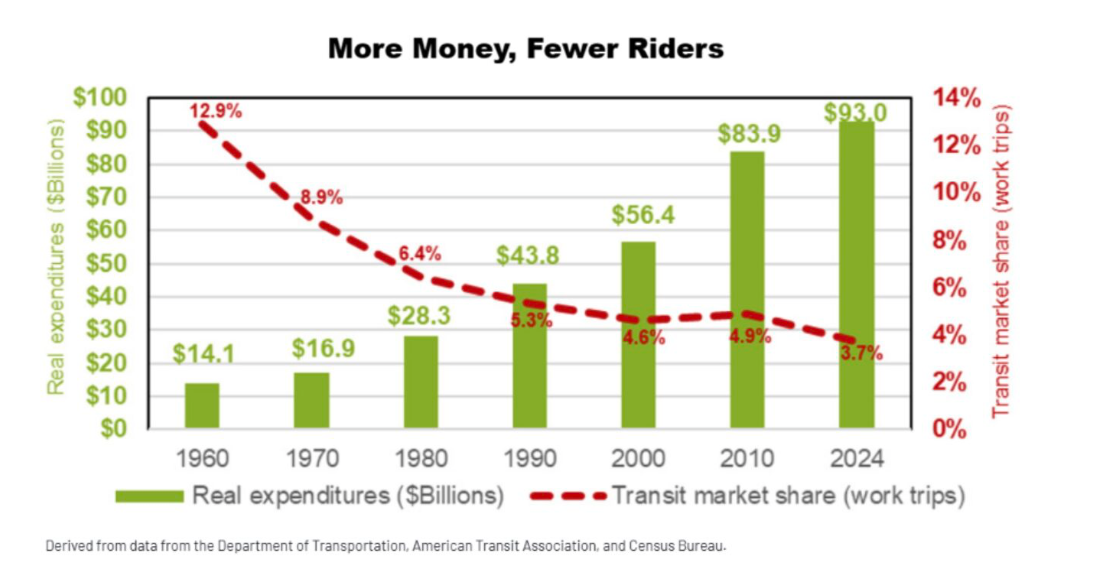
Since 1960, the share of transit commuters dropped from 12.1% to 3.7% in 2024, while the share of Americans driving to work increased from 64% in 1960 to 85% in 2019.
Americans prefer driving and the independence it brings, along with the speed and access, on average taking about half the time it would take to commute to work by mass transit.
.
Between 2019 and 2024, the number of commuters working from home rose to 22.0 million, 3.6 times that of transit commuters, due to the pandemic.
Despite not meeting the goals, federal spending on transit has increased by nearly 50% since 2019, reaching $20.5 billion.
Fox News reports that bus and rail commuting in the United States remains below pre-pandemic levels, despite increased spending by the federal government. While federal support has grown steadily, the share of transit commuters has declined, dropping from 12.1% in 1960 to 3.7% in 2024, according to a report by Unleash Prosperity. The pandemic brought on a new era of telecommuting. Between 2019 and 2024, commuters working from home reached 22 million, 3.6 times the number of transit commuters. Americans prefer driving and the independence that it brings, along with speed and access. It also provides the freedom to accomplish other things while commuting. Since 1960, 88 million more Americans have driven to work, increasing the share of car commuters from 64% in 1960 to 85% in 2019.
Transit commutes involve walking to stations and/or office buildings, making transfers, and waiting for buses or trains, which increases the time of the commute. The average one-way commute is about 26.1 minutes by car, compared with 48.9 minutes by transit. The average carpool travel time was nearly as fast as driving alone, at 27.2 minutes. As the Unleash Prosperity report finds, workers can reach 58.3 times as many jobs in 30 minutes by car as by bus or train in the U.S.’s 50 largest metropolitan areas.
Even in New York City, which has the country’s most extensive public transport network, workplaces are more accessible by car than by mass transit. Cars are able to reach 7.8 times as many jobs in 30 minutes for the average New York metro resident as transit. And the average commute time for residents driving alone in New York City is four minutes faster than the average transit commute (48.3 minutes for driving alone vs. 52.6 minutes for transit).
Background
According to Unleash Prosperity, the federal transit program has been in operation since the 1960s to provide mobility to low-income residents and to reduce traffic congestion and air pollution. However, transit has done little to improve air pollution, which was mainly reduced by improved automotive technology. By the early 2010s, the average new car pollution had been reduced by 99% compared to 1970.
Furthermore, car ownership has increased in the United States. The share of U.S. households without a car declined from 21.5% in 1960 to 8.5% in 2024. A majority of low-income workers (63.5%) commute by car, which almost matches the overall national rate for automobile commuting (69.2%). Only in metro New York State and New Jersey do more low-income workers use transit than automobiles.
In 2024, federal spending on transit reached $20.5 billion — nearly a 50% increase from 2019. During the pandemic period, transit costs continued to rise even as ridership fell. In 2017, federal funding accounted for 34% of total transit expenditures, with state and local governments contributing the remaining 66% (including passenger fares, which are less than 12% of total expenditures).
Transit spending has increased far faster than inflation. Transit expenditures per passenger-mile rose 397% between 1982 and 2019 (2.4 times the 165% increase in overall inflation). Moreover, transit spending per passenger-mile has grown 4.3 times faster than automobile costs, as measured by the Internal Revenue Service standard mileage rate.
Despite this data, transit industry lobbyists are seeking huge federal funding increases for the next federal reauthorization (fiscal years 2027-2031). If successful, federal funding for transit would increase from $108 billion in Fiscal years 2022-2026 to $138 billion in fiscal years 2027-2031.
California Transit Boondoggles
California’s high-speed rail train was initially proposed to connect San Francisco to Los Angeles in two hours and 40 minutes, with a top speed of 220 miles per hour, and was to be finished by 2020 for $40 billion. Its costs have risen above $100 billion, and plans have shrunken to connect Merced to Bakersfield first at a cost of at least $44 billion — a 171-mile project scheduled for completion in 2033. The project started during the Obama administration, which provided $3.5 billion in grants, and President Biden gifted California $3.1 billion from his Infrastructure bill in December 2023, on top of $1 billion he provided earlier.
On top of that boondoggle, California has another project to link the San Fernando Valley and West Los Angeles, which is parallel to the I-405 San Diego Freeway, and connect to the Los Angeles International Airport. In 2016, when it was approved, the 13-mile project was estimated to cost $5.7 billion. Since then, the cost has risen to $20 to $25 billion, and the completion date is 2040 for the proposed underground system.
Los Angeles’s existing subway and light rail system has already cost $20 billion, and current ridership remains well below peak. In 1985, there were 497 million annual boardings on the principal Los Angeles public transit system, which consisted of only buses. By 2024, ridership on both its rail and bus systems dropped to 311 million, a loss of 37% and well below its pre-pandemic level of 370 million riders in 2019. The subway was supposed to reduce traffic congestion in Los Angeles, but that goal has not been accomplished.
Analysis
Mass transit has not met its stated goals of providing mobility for low-income residents and reducing traffic congestion and air pollution, as more and more Americans own cars with improved technology and use them to commute to work. home. Americans are choosing not to use public transit due to time, access, and mobility, despite the government increasing its spending on transit projects.
For inquiries, please contact wrampe@ierdc.org.

