

Key Takeaways
FERC has issued its annual summer assessment covering markets and reliability, which finds that grid reliability will improve from last year.
A large increase in capacity – the largest one-year increase in over a decade – combined with a slowdown in unit retirements, results in adequate operating reserves across all NERC assessment areas under normal conditions.
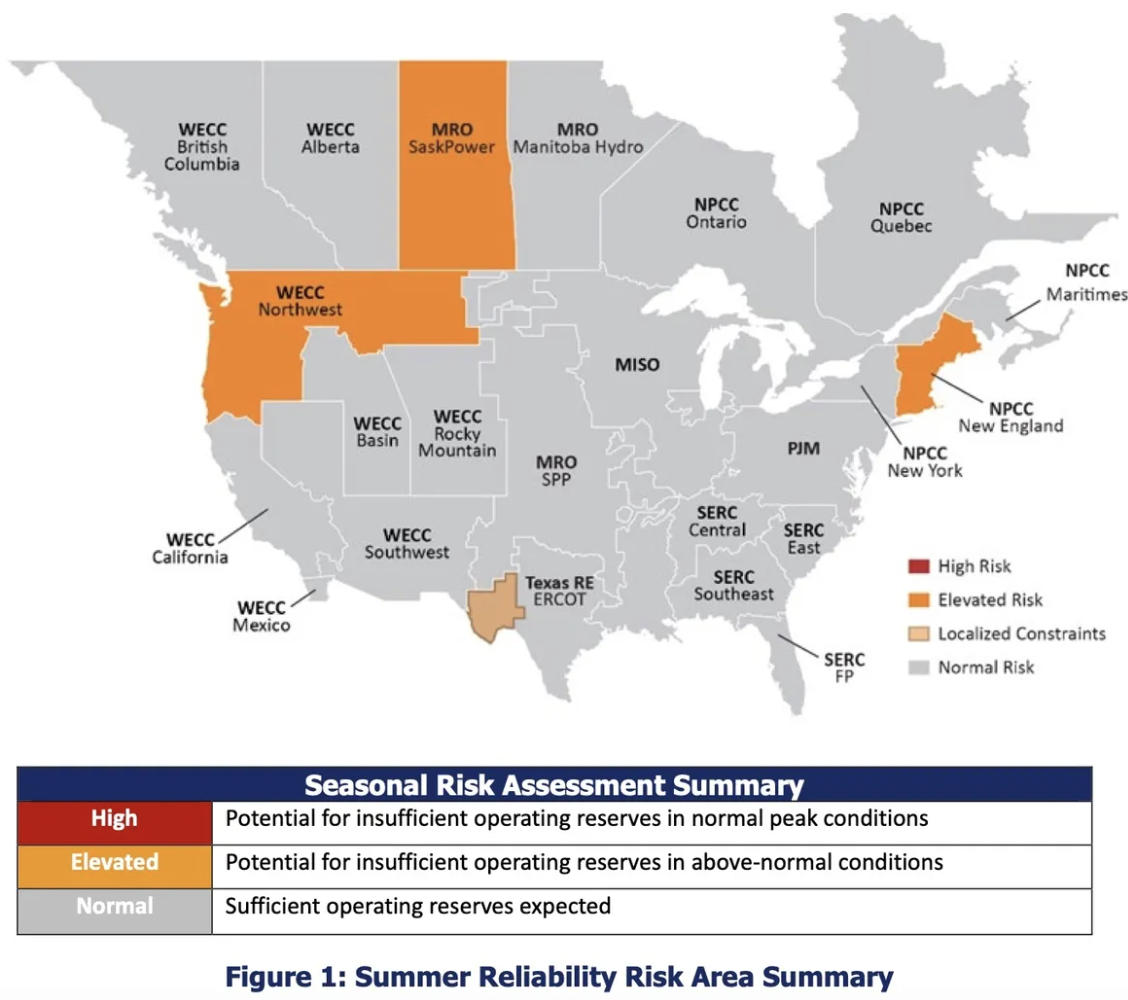
Extreme weather conditions and reduced water levels could challenge the grid in the Pacific Northwest, New England, and parts of western Texas.
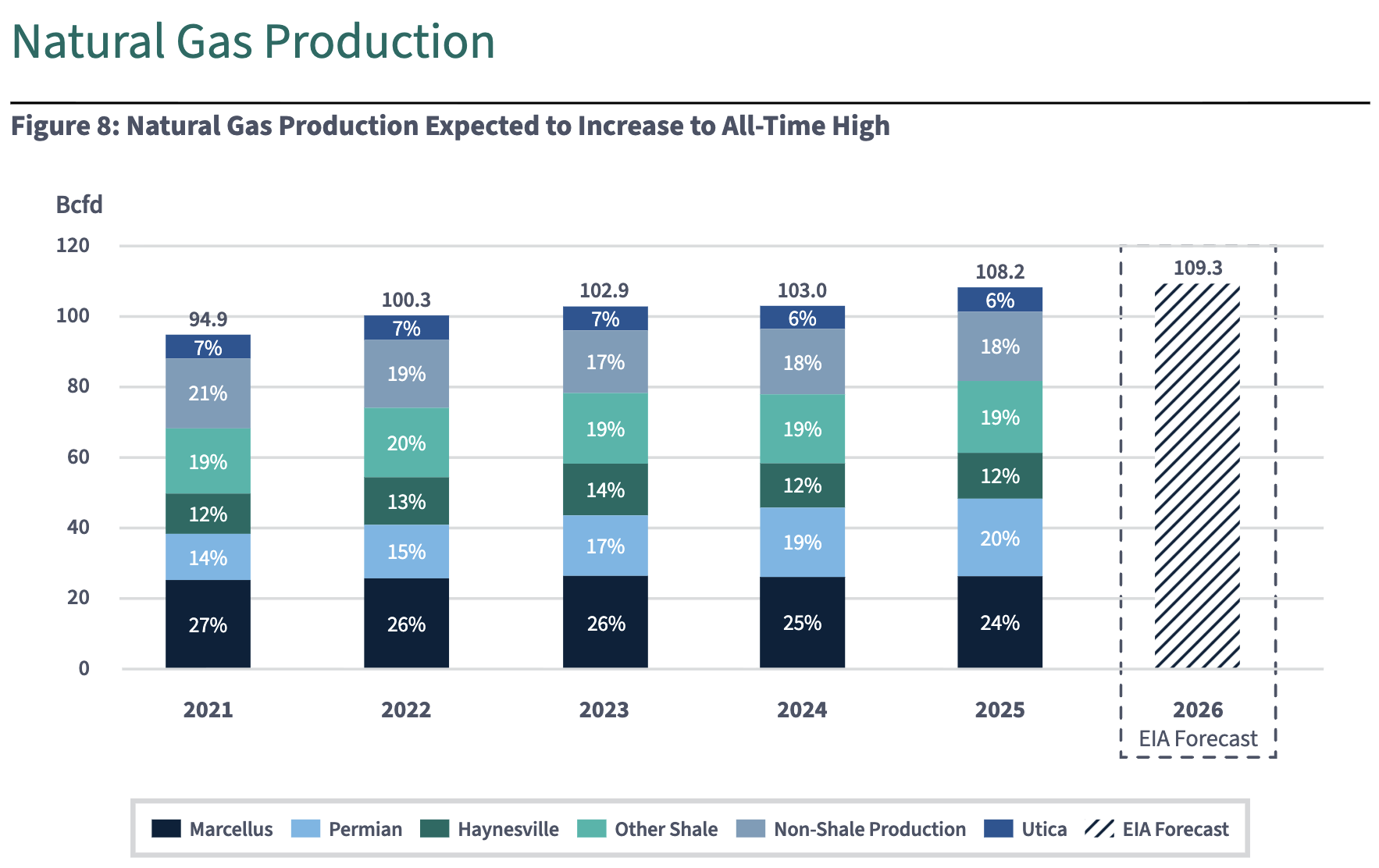
Increases in natural gas production and consumption are expected this year, and some fossil-fuel plants are required to remain open under DOE orders.
The capacity additions are heavily weighted towards solar and wind as the subsidy schemes of the Inflation Reduction Act continue, but because of their lower capacity factors, they provide less capacity to support grid reliability.
Batteries, although some consider them capacity, serve as storage for other types of generation, are expensive, and are driven largely by intermittent renewable sources.
With rising electricity demand, largely driven by data centers in the United States, FERC is pursuing options to speed the deployment of additional generation, which would also help limit costs.
According to the Federal Energy Regulatory Commission (FERC), U.S. grid reliability will improve this summer as 75 gigawatts of capacity are being added to the grid, and power plant retirements are expected to slow by more than 50% to 8 gigawatts. The increase in capacity is the largest one-year increase in over a decade. With the added capacity, resources, and operating reserves are expected to be adequate in all NERC assessment areas under normal operating conditions. However, high temperatures and extreme weather events, such as low snowpack, continued drought, and wildfires, could strain the grid in certain areas. Low water levels are also expected to restrict hydropower generation in key regions, particularly in the Colorado River Basin, where about 4.5 gigawatts of hydroelectric generation could be affected by August.
According to FERC’s annual summer market and reliability assessment, the capacity additions include nearly 26 gigawatts in the Electric Reliability Council of Texas footprint, close to 13 gigawatts in the Western Electric Coordinating Council region, and 11 gigawatts in the Midcontinent Independent System Operator region. Even with the new capacity, three areas in the United States face risks of power supply shortfalls during extreme conditions: the Pacific Northwest, New England, and part of western Texas.
Natural gas demand and production are both expected to increase, providing more generation. U.S. natural gas demand is expected to average 101.3 billion cubic feet per day this summer, 1.6 billion cubic feet per day more than summer 2025 levels and 8% more than the previous five-year summer average of 93.8 billion cubic feet per day. FERC expects gas-fired generators will provide 39% of capacity this summer, followed by solar at 14%, coal at 13%, wind at 12%, and nuclear and hydropower at 7% each. The new capacity consists of 7 gigawatts of gas, 30.5 gigawatts of solar, of which only 16.4 gigawatts contribute during peak summer demand due to its inefficiencies, and over 16 gigawatts of expensive battery storage capacity. The capacity additions are heavily weighted towards solar and wind as the subsidy schemes of the Inflation Reduction Act continue.
Natural gas production is expected to be slightly higher this summer than last, driven by continued strong production from major shale fields. The Energy Information Administration (EIA) forecasts U.S. dry natural gas production to average 109.3 billion cubic feet per day during summer 2026–a 1% increase from the summer 2025 average of 108.2 billion cubic feet per day and is 7% above the previous five-year average of 101.8 billion cubic feet per day.
Total electricity consumption is projected to reach 1,587 terawatt-hours this summer. EIA forecasts that electricity consumption from June to September 2026 will increase by 106 terawatt hours from the summer of 2021–a 7% increase. Summer 2026 is projected to grow 3% year-over-year compared to summer 2025, the most significant year-over-year growth since summer 2022, and is 4.5% above the previous five-year average of 1,518 terawatt hours. EIA’s projections for monthly consumption this summer indicate demand will peak in August 2026, at 426 terawatt-hours, a 5% increase from August 2025.
In several regions, coal and natural gas-fired plants that were slated to retire, more than 4,300 megawatts, are continuing to operate pursuant to DOE Orders under section 202 (c) of the Federal Power Act (FPA).
NERC projects that summer peak demand across North America will grow by about 224 gigawatts over the next decade, a 69% increase over the previous year’s ten-year forecast and about a 24% increase from 2025 peak demand. Most of the new load is due to an increasing number of new data centers.
More new generating capacity is coming as power pools are fast-tracking interconnection reviews to get power supplies online quickly. SPP is advancing about 13.3 gigawatts concentrated in Oklahoma, Kansas, and Texas, with 2029/2030 online targets, and MISO is advancing 20.9 gigawatts mainly in Louisiana, Indiana, and Wisconsin, with 2027/2028 in-service dates.
To speed up permit times, FERC has proposed expanding its “blanket certificate” program for certain types of “routine” gas pipeline projects deemed not to require project-specific authorizations. The program was last updated in 2006. Projects identified as high risk, however, will continue to undergo a comprehensive review. In addition to gas pipeline projects, FERC is advancing blanket authorization initiatives for liquefied natural gas and hydropower facilities.
Analysis
FERC’s summer assessment views the grid to be reliable this summer under normal conditions. Under extreme weather conditions, three regions in the United States (the Pacific Northwest, New England, and part of western Texas) face risks of power supply shortfalls. U.S. utilities are adding 75 gigawatts to the grid this summer, composed of solar, wind, natural gas, and battery resources. While that increase is the largest one-year increase in over a decade, caution is warranted given the intermittency of wind and solar power, which provide only a fraction of their design capacity because the wind and sun are unreliable energy sources. Further, storage batteries are expensive and are not generators in themselves; they store power generated by other sources and release it when needed. The Trump administration has also slowed the retirement of over 4.3 gigawatts of fossil fuel generators, which will help this summer if needed.

