

Key Takeaways
Europe was already suffering from high energy prices before the Iran conflict, as climate policies and other factors lifted prices there much higher than those in Asia and the United States.
Higher rates of renewable energy adoption in Europe have not reduced electricity prices, but have instead led to the offshoring of critical industrial production.
With the loss of LNG exports from the Gulf and significant damage to Qatar’s production facilities from an Iranian attack, Europe will compete with Asian markets for LNG, which will keep prices relatively high even when the Strait of Hormuz reopens.
Damage and price increases in exports extend beyond oil and LNG to include fertilizer, minerals, and petrochemicals.
The U.S.’s commitment to energy dominance under President Trump has insulated it from the disruptions of higher dependence experienced in other parts of the world and reaffirmed the importance of energy production to national and economic security.
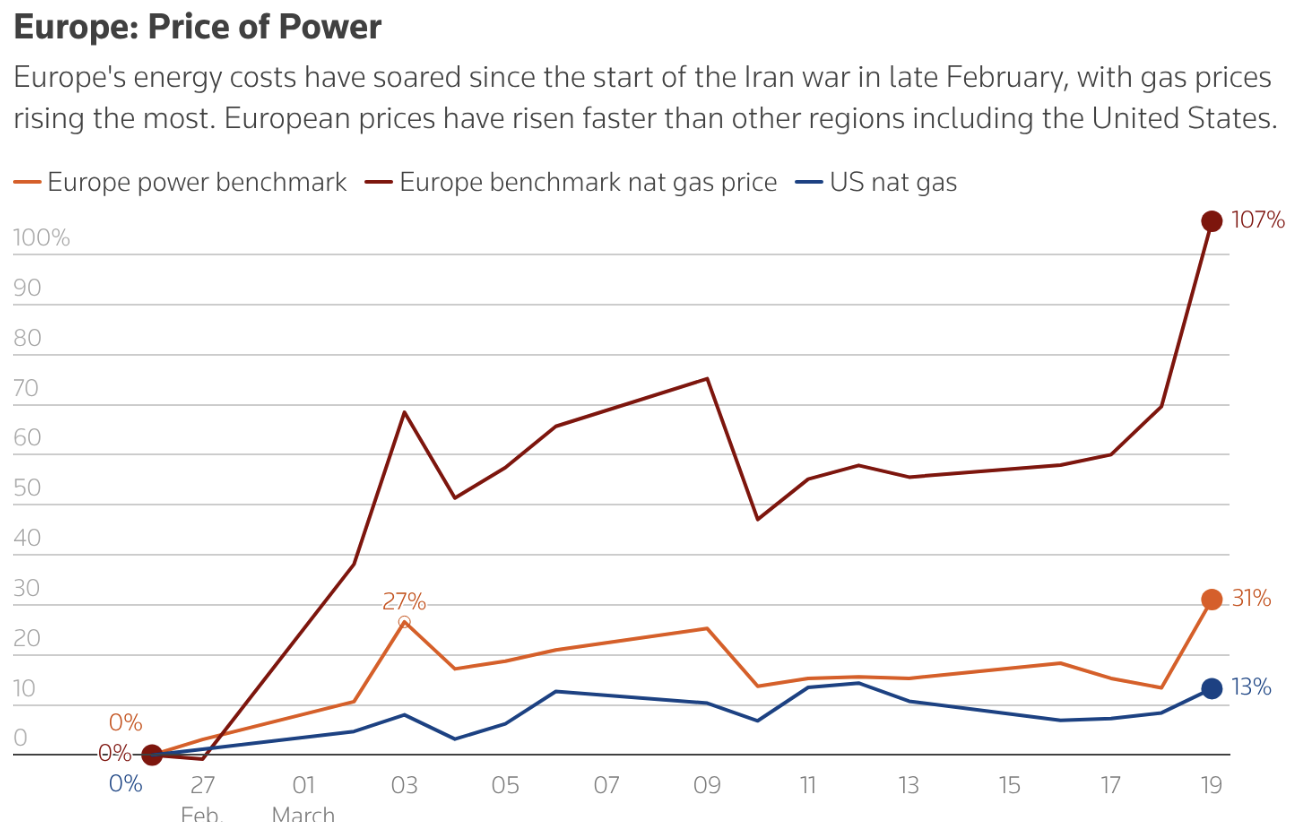
The conflict with Iran is hitting Europeans very hard because energy prices were already higher there than in other regions due to Russia’s invasion of Ukraine, U.S. tariffs, European tax and climate policies, and bans/moratoria on fracking. Europe’s industries have faced years of high energy costs, enabling Chinese competition and leading to plant closures. Fears of deindustrialization were already common before the impacts of the Strait of Hormuz closure began to affect the continent. Germany’s economy, Europe’s biggest, could face a $46 billion hit over two years if oil stays at $100 a barrel, according to the IW German Economic Institute.
According to Reuters, Germany has some of the highest wholesale power prices worldwide at $132 per megawatt hour, significantly above $48 per megawatt hour in the United States and higher than the EU average of $120 per megawatt hour, according to International Energy Agency data. Germany has phased out its nuclear fleet and turned to renewable energy, which accounted for 55.9% of its electricity generation in 2025, mostly from intermittent wind and solar power. Its Energiewende by 2030 requires 80% of the electricity supply to come from renewable energy sources, rising to 100% by 2035.
Iran’s blockade of the Strait of Hormuz after various strikes on both sides of the Iran conflict propelled Brent oil prices to almost $120 a barrel, double the price at the start of 2026, before dropping below $100 a barrel due to President Trump’s announcement of ongoing talks with Iran. The closure of the Strait of Hormuz resulted in the reduction of about a fifth of global oil consumption that flows through the strait, with most of it headed for Asia.
According to the Wall Street Journal, liquefied natural gas (LNG) facilities in Qatar, the second-biggest supplier of LNG globally after the United States, are expected to be offline for months. That means the world is losing nearly 12 billion cubic feet per day of natural gas supplies, or about one-fifth of global LNG supplies. Qatar will not be able to resume production at prewar levels due to extensive damage to Qatar’s Ras Laffan hub. QatarEnergy lost about 17% of its LNG export capacity when it was struck by Iran, and repairs are expected to take up to five years, with the damage affecting LNG supply to markets in Europe and Asia. QatarEnergy expects to lose about $20 billion in annual revenue. According to S&P Global Energy, other global LNG projects could theoretically add 2.3 to 2.8 million tons per month from April through June, which would not be enough to cover the roughly seven million tons Qatar produced per month before the Iran conflict began.
Besides the disruption to oil and gas markets, supplies of fertilizers, sulfur, helium, aluminum, and other critical raw materials have been affected by Iran’s effective closure of the Strait of Hormuz, as the region accounts for significant production of all of them. Shipping costs have also surged.
Some Asian suppliers, which rely on oil from the Middle East, had declared force majeure, pushing up the price of their products. As the Journal reports, the supply crunch due to the closure of the strait is expected to lead to shutdowns at refineries and petrochemical complexes in Asia, which in turn will affect the output of products such as plastics. For example, one French company has suppliers in Vietnam and Thailand who have experienced force majeure and cannot ship raw materials, from which the French company gets 40,000 to 50,000 metric tons of polymers a year, Reuters reports.
According to Reuters, the French trade association Polyvia, which represents plastics and composites companies, is raising concerns with the government, saying suppliers are using soaring gas costs to renegotiate contracts and push for higher prices. European governments have less fiscal room than in 2022 to shield industry with massive subsidies. Therefore, if oil heads towards $130 a barrel, there will be a significantly greater risk of default in sectors such as metals and chemicals.
The United States Is in a Different Position
Due to President Trump’s energy dominance program and the nation’s vast energy resources, the United States is in a different position than Europe. U.S. West Texas Intermediate oil prices are about 10% lower than Brent oil prices, and retail gasoline prices are less than $4 a gallon, on average, as of March 26. The United States is also the world’s largest producer of oil and natural gas and a major oil and gas exporter, selling 8.9 trillion cubic feet of LNG in 2025.
Countries are looking for secure supplies and turning to the United States. Asian refiners are sending oil cargoes from the U.S. Gulf Coast to Asia through the Panama Canal due to the closure of the Strait of Hormuz. U.S. oil producers are increasing production wherever possible and where they are not constrained by infrastructure. In the Permian Basin, for example, oil production growth is limited by associated gas production because excess pipeline capacity does not exist to transport it. Oil companies are also wary about adding drilling rigs because it is unclear how long the Strait of Hormuz will remain closed. Its opening will lower oil prices as more supply will be available.
Analysis
U.S. energy abundance is protecting American consumers from the severe price shocks seen in Europe due to the conflict with Iran. European energy prices were high even before the conflict began, largely due to climate regulations and subsidies for renewable energy technologies that crowd out reliable sources. How long prices will remain elevated depends on how long the Strait of Hormuz remains effectively closed. Once opened, it will take some time for producers to gear up production.
For inquiries, please contact wrampe@ierdc.org.

