

Key Takeaways
The unresolved conflict in Iran continues to roil markets as the United States and Iran trade strikes and oil prices increase toward $80 a barrel.
Iran says the Strait of Hormuz is closed as it does not recognize ships transiting Oman’s coast as legitimate.
The United States has reinstated the naval blockade of Iranian ports.
President Trump has suggested the U.S. might provide security to ships transiting the strait for a fee.
Stocks of oil, petroleum products, and natural gas continue to deplete, with Europe especially hard hit.
The ongoing problems are prompting nations in the region to seek pipelines and other alternative transport routes, with some analysts predicting substantial future shifts in existing transportation patterns.
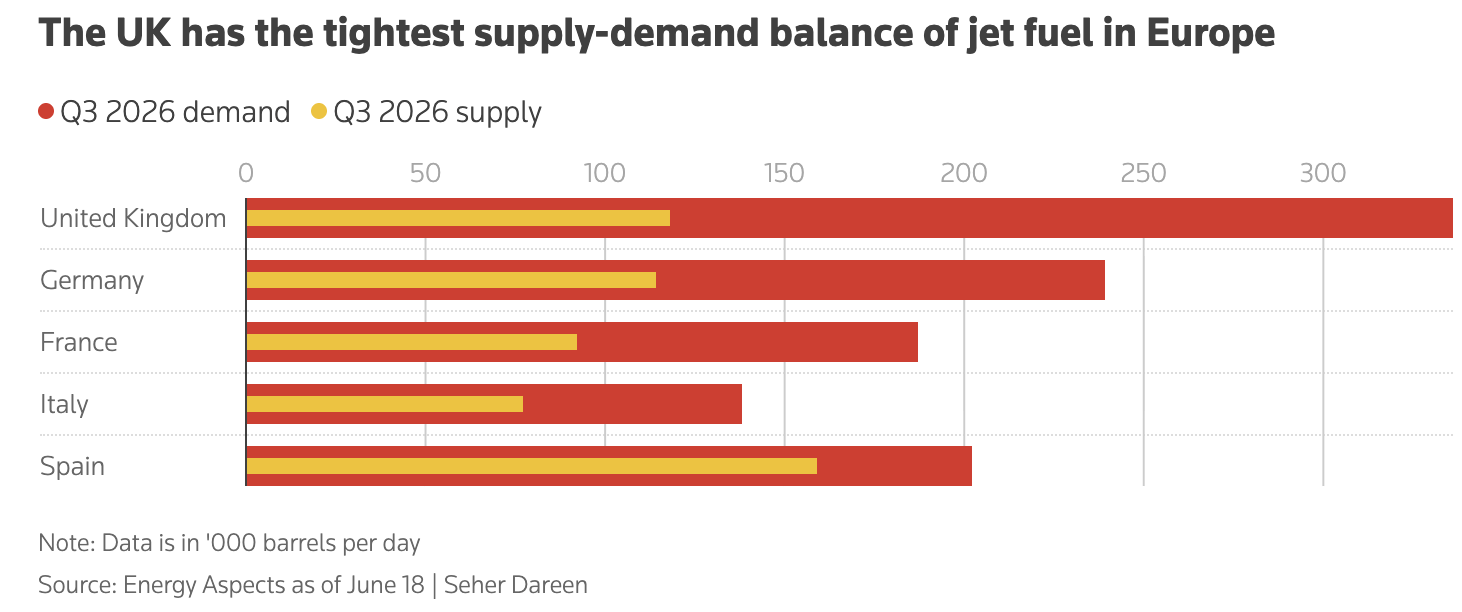
As the Iran Conflict continues, the world continues to tap storage, which is turning thin after four-and-a-half months of disruption. On July 3rd, the U.S. emergency oil reserve, the Strategic Petroleum Reserve, stood at just over 319 million barrels, about 19 million barrels from its minimum operating level. Because of equipment failures, the salt caverns that hold the stocks cannot be drawn from or refilled at the rate at which they were designed. Oil storage at the private commercial storage hub in Cushing, Oklahoma, is at about 19.6 million barrels, around 25.8% of its total 76-million-barrel capacity, which is near the “operational minimum.” That means the hub is mostly composed of unusable sludge or sediment at the bottom of the storage tanks. Europe has less than a month of aviation fuel supplies — the tightest of the major jet fuel markets. Europe’s LNG imports dropped to their lowest level in nearly two years as the refilling of natural gas inventories fell behind schedule, with a storage deficit of 158 terawatt-hours as of July 7, about 22% larger than the 10-year seasonal average.
A few tankers continue to transit the Strait of Hormuz, though the number is unclear since some vessels switch off their transponders to avoid detection. The few vessels that transit, however, are a fraction of those that transited before the war with Iran, which began at the end of February.

According to President Trump, the Strait of Hormuz is open to commercial traffic, although Iran had declared the strait closed after it attacked a vessel that traveled on an unapproved route near the Omani coastline, which reignited attacks by both sides. CNBC reports that the southern route through Oman’s waters remains open to inbound and outbound traffic, citing a statement from the Joint Maritime Information Center, a U.S.-led naval coalition in Bahrain that provides security updates to civilian ships transiting the Middle East. Iran’s top joint military command had earlier said it would not allow the United States to intervene in the management of the strait and that any attempt to transit without its authorization would be confronted.
President Trump also announced that the United States was reinstating a naval blockade on Iran and that the United States would “be reimbursed, at the rate of 20% on all cargo shipped, for any and all costs necessary to do the job of providing safety and security to this very volatile section of the World.” Opposing Trump’s proposal, the UN’s shipping agency said it was opposed to any fees for straits used for international navigation, stressing that there is no legal basis for introducing mandatory tolls on strait transits.
Due to the strikes over the July 11/July 12 weekend, Brent oil futures, the international benchmark, rose 5.3% to $80 per barrel. West Texas Intermediate futures were 5.3% higher at $75.18 a barrel.
Europe’s Jet Fuel Inventories
Until war broke out at the end of February, Europe had relied on the Middle East for around half of its jet fuel imports. A supply deficit is expected across Europe of nearly 600,000 barrels per day in the third quarter, while the United States expects to see surpluses of 116,000 barrels per day and the Asia-Pacific region expects to see surpluses of 425,000 barrels per day. Reuters reports that Europe’s jet fuel inventories were at 38 million barrels at the start of June, which leaves Europe with less than 30 days of demand cover. Europe has imported jet fuel from the United States and Asia, raised its refiners’ output, and drawn on stocks to keep planes in the air. Britain, France, and Germany are particularly vulnerable due to decades of refinery closures, making them more reliant on Middle Eastern shipments via the Strait of Hormuz.
More Oil Pipeline Capacity to Bypass Hormuz
Some analysts expect countries to develop ways to permanently bypass the Strait of Hormuz. According to Reuters, Goldman Sachs estimated that expanding pipeline capacity in the Middle East could shield more than 60% of pre-war Gulf oil exports from future Hormuz disruptions by the end of 2028. The bank’s base-case forecast assumes pipeline capacity will increase by 3.8 million barrels per day by the end of 2027 and by 7.3 million barrels per day cumulatively by the end of 2028, taking total effective bypass capacity to more than 14 million barrels per day by the end of 2028.
Saudi Arabia is considering expanding the capacity of its East-West oil pipeline by up to 2 million barrels per day, allowing more exports to bypass the Strait of Hormuz. The existing East-West pipeline can now ship up to 7 million barrels per day from the country’s eastern oil fields to the Red Sea export terminal at Yanbu. About 2 million barrels per day are for domestic refinery use, and about 5 million barrels per day are for export. Like Saudi Arabia, the United Arab Emirates (UAE) can avoid the strait by using its oil pipeline to Fujairah, which carries up to 1.8 million barrels per day. The country has completed half of a new West-East pipeline that will double its crude oil capacity when it becomes operational next year.
Conclusion
The conflict in Iran continues with the United States and Iran exchanging strikes and oil prices increasing toward $80 a barrel. Iran considers the Strait of Hormuz closed as it does not recognize transit near Oman’s coast as a viable passageway. Vessels continue to use it, risking attacks from Iran. The United States is reinstating its naval blockade on Iranian ports, and President Trump has suggested the U.S. charge for safe and secure passage via the strait. At four and a half months into the conflict, oil, petroleum products, and natural gas stocks are running very low, with some nearing their operational minimum levels. Some analysts expect Middle East producers to work on ways to bypass the strait in the future, most likely by building pipelines.
For media inquiries, please contact press@ierdc.org.

