

Key Takeaways
Oil prices rose after the United States seized an Iranian cargo ship attempting to elude the blockade over the weekend.
This was the first altercation of the blockade, which has successfully turned away many ships.
DOE Secretary Chris Wright and President Trump have said that oil and gasoline prices could remain elevated throughout the year, even if hostilities in the region cease.
With the world’s oil supply affected by the shutdown of the strait and damage to production facilities from Iranian attacks in the region, a rapid return to previous levels will be difficult.
In the wake of higher oil prices, registrations for electric vehicles in Europe and Asia are up, with cheap electricity in parts of Asia from coal and hydroelectric power making them attractive.
Iran is vowing to retaliate after the United States attacked and seized an Iranian cargo ship over the weekend that tried to break through the U.S. blockade, raising oil prices the morning of April 20 by 6%. Via the New York Times, Brent crude oil, the international benchmark, rose to around $95 a barrel — about $8 above lows on Friday, April 17. The Strait of Hormuz remains largely shut as the ceasefire agreement is set to expire this week. The strait was open for one day on April 18 when more than 20 ships passed through it, carrying oil, liquefied petroleum gas, metals, and fertilizers, which was the highest number of vessels crossing the waterway since March 1.
According to the New York Times, before attacking the Iranian cargo ship, the U.S. Navy spent six hours requesting the ship to stop and turn around, marking the first time a vessel entering or exiting Iranian ports tried to evade the U.S. blockade of ships. Previously, 25 other ships intercepted by the U.S. Navy outside the strait had turned around when approached by the Navy. Last week, the United States extended its blockade on vessels coming in and out of Iranian ports to all waters worldwide, indicating that it would pursue any ship aiding Iran, regardless of location or flag.
According to AAA, the average national gasoline price was $4.04 per gallon on April 20. The New York Times reports that Energy Secretary Chris Wright indicated in a CNN interview that while the average price of U.S. gasoline had probably peaked, it may not fall to below $3 a gallon until next year. Before the U.S.-Iran conflict began, the average national price for a gallon of regular gas was $2.98 — 26% lower than the average price on April 20. Earlier this month, President Trump acknowledged that gas prices may remain elevated through the midterm election. The ceasefire remains unstable, shipping traffic through the strait, where 20% of the world’s oil passes, is way below normal levels, and much of the damaged oil production facilities in the Middle East could take months to return to normal levels.
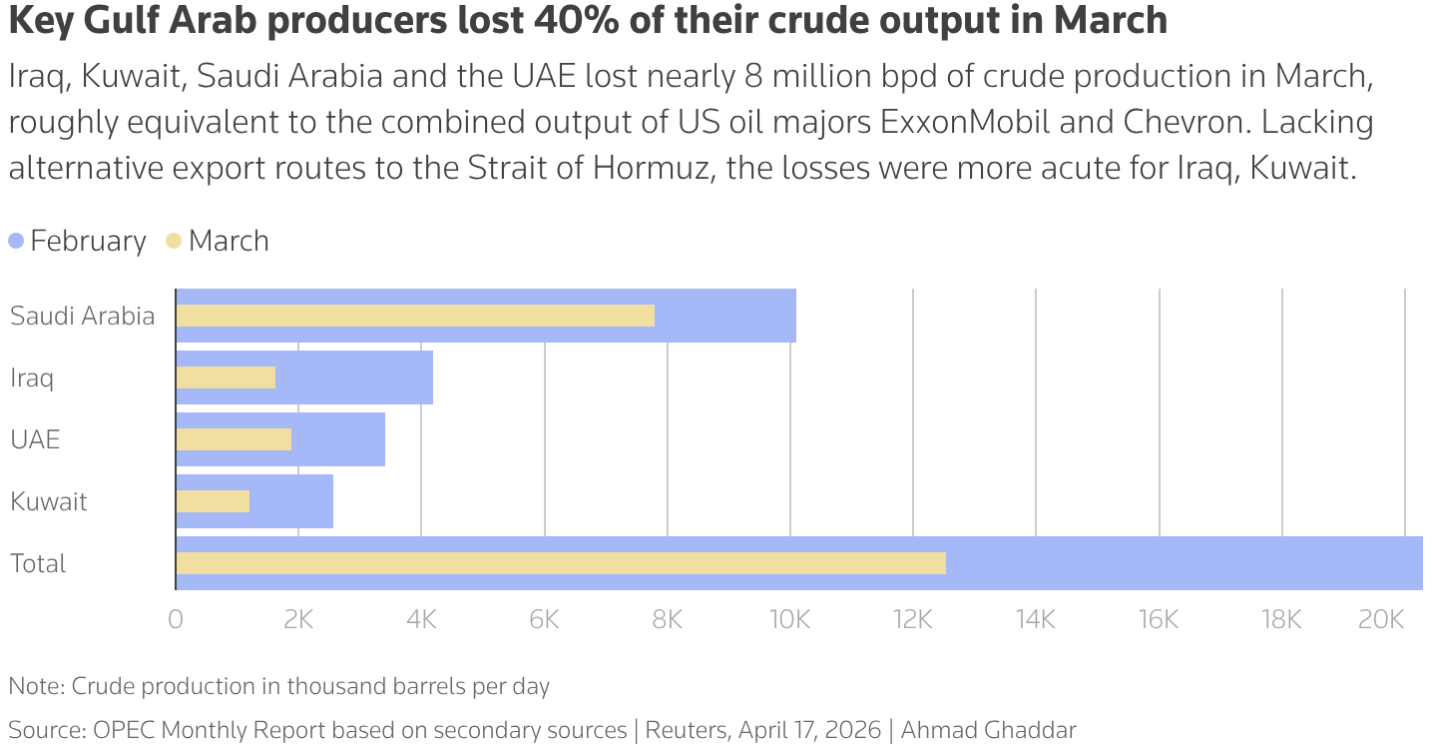
As the New York Times explains, dozens of refineries, storage facilities, and oil and gas fields in at least nine countries, from Iran to the United Arab Emirates, were targeted in the Iranian strikes. About 10% or more of the world’s oil supply is turned off. Restarting those operations will require inspecting pumps, replacing processing equipment, and summoning back employees and ships from abroad. Oil stockpiled, however, will begin to immediately flow once the strait is successfully opened, and some undamaged wells are likely to flow within days or weeks. Infrastructure that has sustained extensive damage is expected to take years to repair.
More EV Sales Are an Outcome of the Closure of the Strait
Reuters reports that sales of fully electric cars in Europe’s main auto markets increased by almost a third in the first quarter of 2026 as drivers opted for alternatives to gas and diesel vehicles. New battery-electric vehicle (BEV) registrations, a proxy for sales, increased 29.4% from last year to almost 560,000 in the quarter and were up 51.3% at over 240,000 in March in 15 European markets. In Britain, Europe’s second-biggest BEV market after Germany, BEV registrations grew 12.8% in the first quarter and accounted for 22.5% of new car sales in the country.
Via the South China Morning Post, EV adoption is picking up in South Asia’s largest economy as India recorded more than 2.5 million new EV registrations in the year to March 2026, a 24% increase year on year. EV penetration reached nearly 8.5% of total vehicle registrations, up from 7.7% the previous financial year. Two-wheelers led the way, accounting for 58% of total EV sales.
Asia was already making inroads into the EV market before the war in Iran began. EV sales were over a quarter of global new car sales last year, and emerging markets comprised a growing share. Southeast Asian EV sales rose to 55,000 vehicles a month in the last quarter of 2025, up from 32,000 monthly sales a year earlier. Vietnam doubled its share of EV car sales last year. Thailand’s sales share reached 20%, up from 1% in 2019. Some countries that have seen strong growth of EVs, like Nepal, where over 70% of vehicles sold are electric, have inexpensive hydropower and plentiful electricity. Other countries rely on cheap coal for electricity generation.
Due to the conflict in Iran and the effective closure of the Strait of Hormuz, Wood Mackenzie estimates that roughly 80 million new passenger EVs could enter the global market by 2030.
Analysis
Over the weekend, the United States attacked and seized an Iranian cargo ship after trying to get it to turn around before it reached the Strait of Hormuz, as the U.S. blockade of Iranian ports continues. The U.S. blockade will damage Iran’s war effort, but sustained involvement could pose problems for the U.S. as well. As IER’s Caleb Jasso explains for RealClearEnergy, “For the U.S., putting even greater pressure on Iran by blocking its access to the Strait of Hormuz, while working to ensure the security of all other vessels transiting it, may prove decisive in pressuring Iran to capitulate. However, the risk for the U.S. remains that the political will of those who support the current action being taken against Iran will continue to deteriorate the longer it takes and the more costly it becomes, especially at the gas pump.”
For inquiries, please contact wrampe@ierdc.org.

