Energy affordability has become a top concern for American families and businesses. A recent poll conducted by Ipsos found that 73% of U.S. residents were concerned about their electricity and gas bills rising this year, and 80% of Americans admitted they feel powerless over how much they are charged for these utilities.
These affordability concerns are well-founded. Federal data show U.S. electricity prices increased by 27% from January 2021 through January 2025 and by an additional 11% from January through September 2025, placing additional strain on Americans’ finances.
Electricity prices are especially high in traditionally liberal areas of the country. In total, 86% of states with electricity prices above the national average in the continental U.S. are reliably blue, having voted for the Democratic nominee for president in the 2020 and 2024 elections.3 In contrast, 80% of the 10 states with the lowest electricity prices are reliably red, defined as having voted for the Republican candidate in these contests. This report explains how state-level energy policies primarily shape electricity and highlights five states (California, Florida, Louisiana, Kentucky, and New York) to illustrate how these policies affect affordability.
Expensive Electricity Is A Choice: How States Shape Electricity
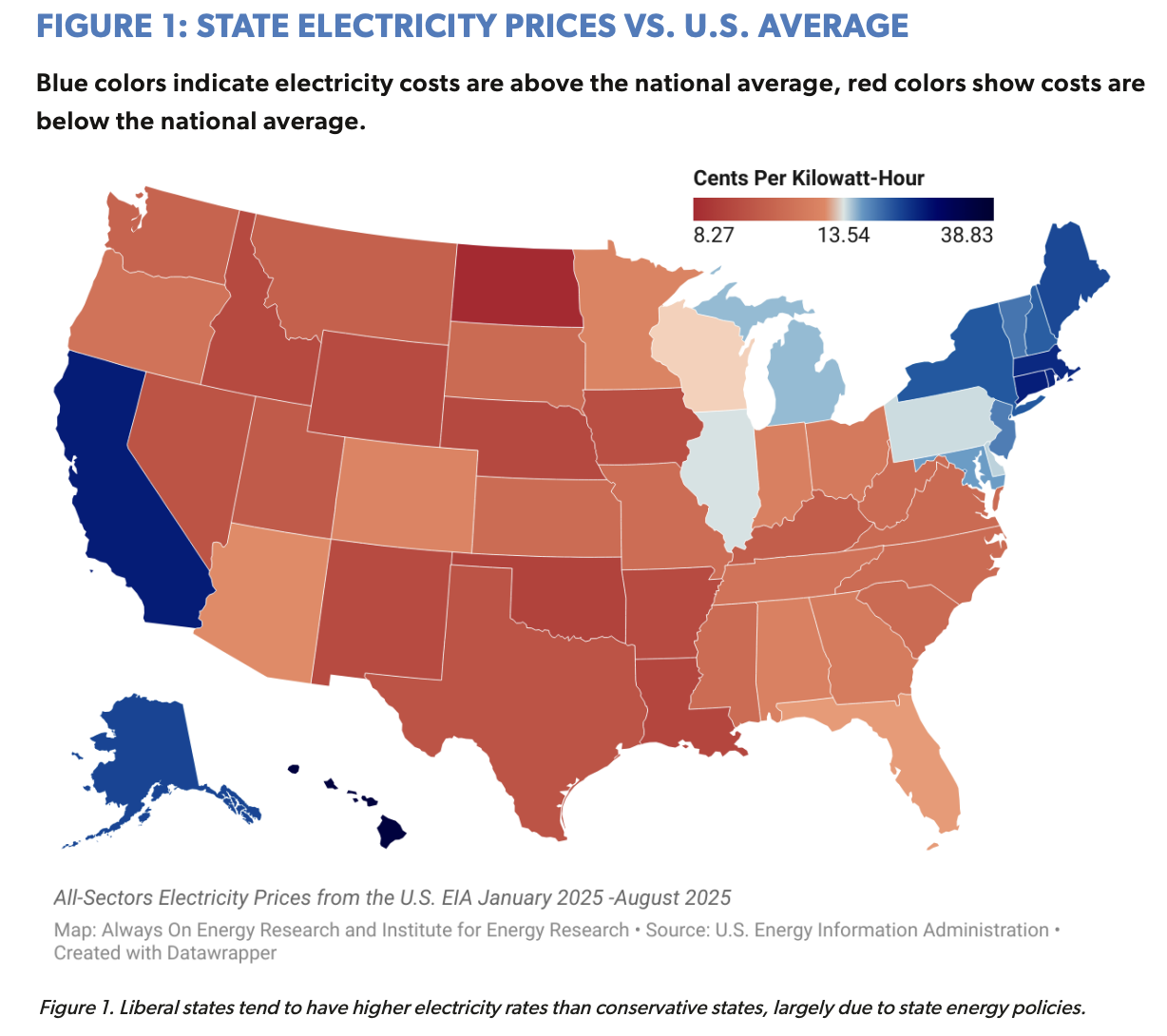
The data is clear: bluer states tend to have much higher electricity prices than red states.
More than almost any other product, electricity prices are a direct result of state energy policies because states have the exclusive power to decide which resources supply their grids.
Under the Federal Power Act (FPA), Congress preserved expansive state powers to regulate the electricity generated and sold within their borders. These powers allow states to determine their generation portfolios, site and permit power generation facilities outside nuclear and hydroelectric plants, regulate retail prices, and exercise authority over resource adequacy and reliability, meaning states are charged with ensuring that utilities, and electric cooperatives, often referred to as load serving entities (LSEs), maintain adequate power plant capacity to keep the lights on.
States can also enact energy policies requiring a certain percentage of retail electricity sales in the state to come from renewable generation under a renewable portfolio standard (RPS), or can set energy efficiency resource standards (EERS) or clean energy standards (CES).
The broad authority of states to determine their generation portfolios, set retail electricity prices, and establish mandates for wind and solar generators under the FPA has led to a diversity of policies that ultimately determine the price of electricity for families and businesses in the United States.
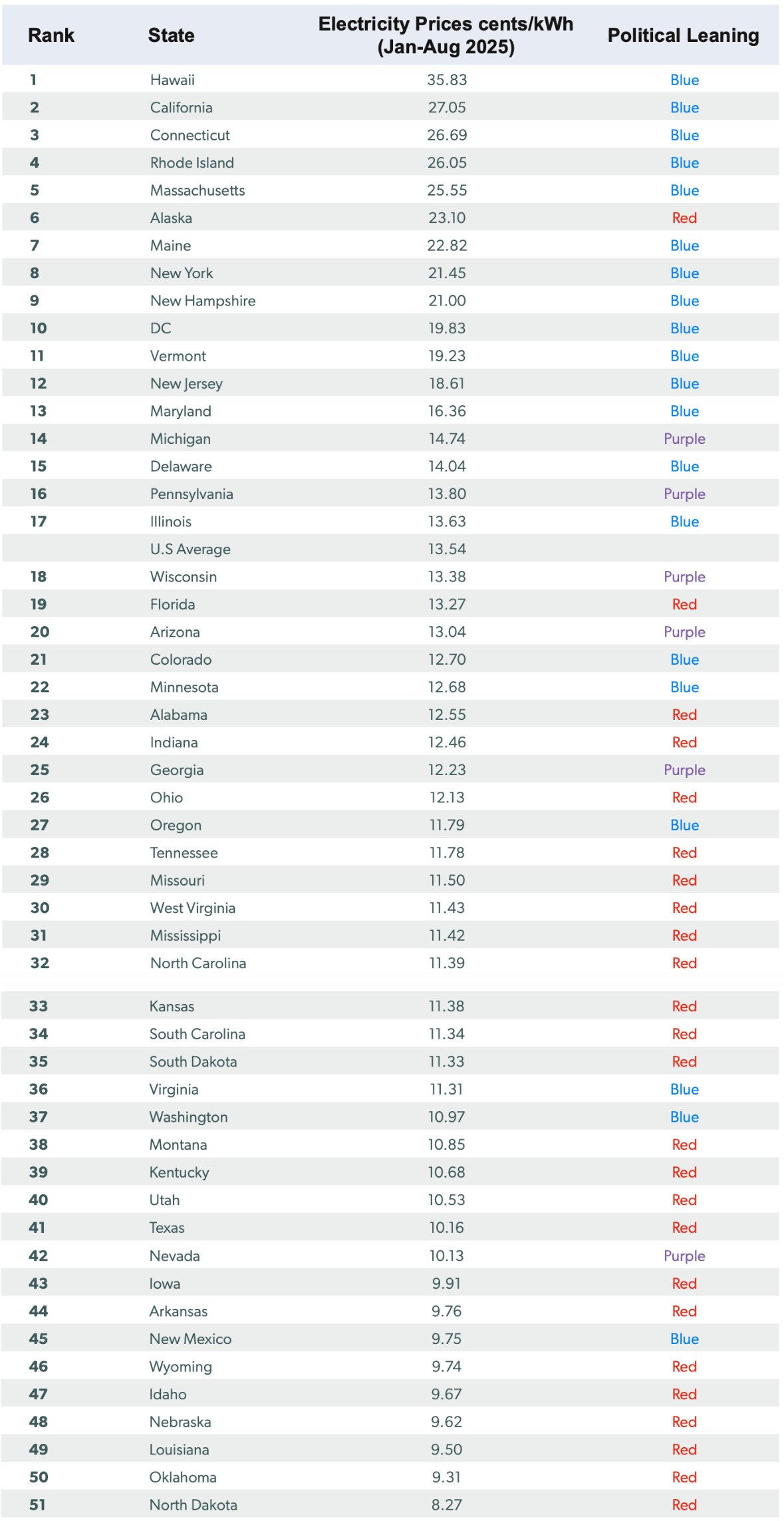
For example, Figure 1 shows the average all-sectors electricity price for each state from January 2025 through August 2025. In total, 86% of states with electricity prices above the national average of 13.54 cents per kilowatt hour (kWh) in the continental U.S. are reliably blue, having voted for President Biden in 2020 and Vice President Harris in 2024 (see Table 1 in the Appendix).
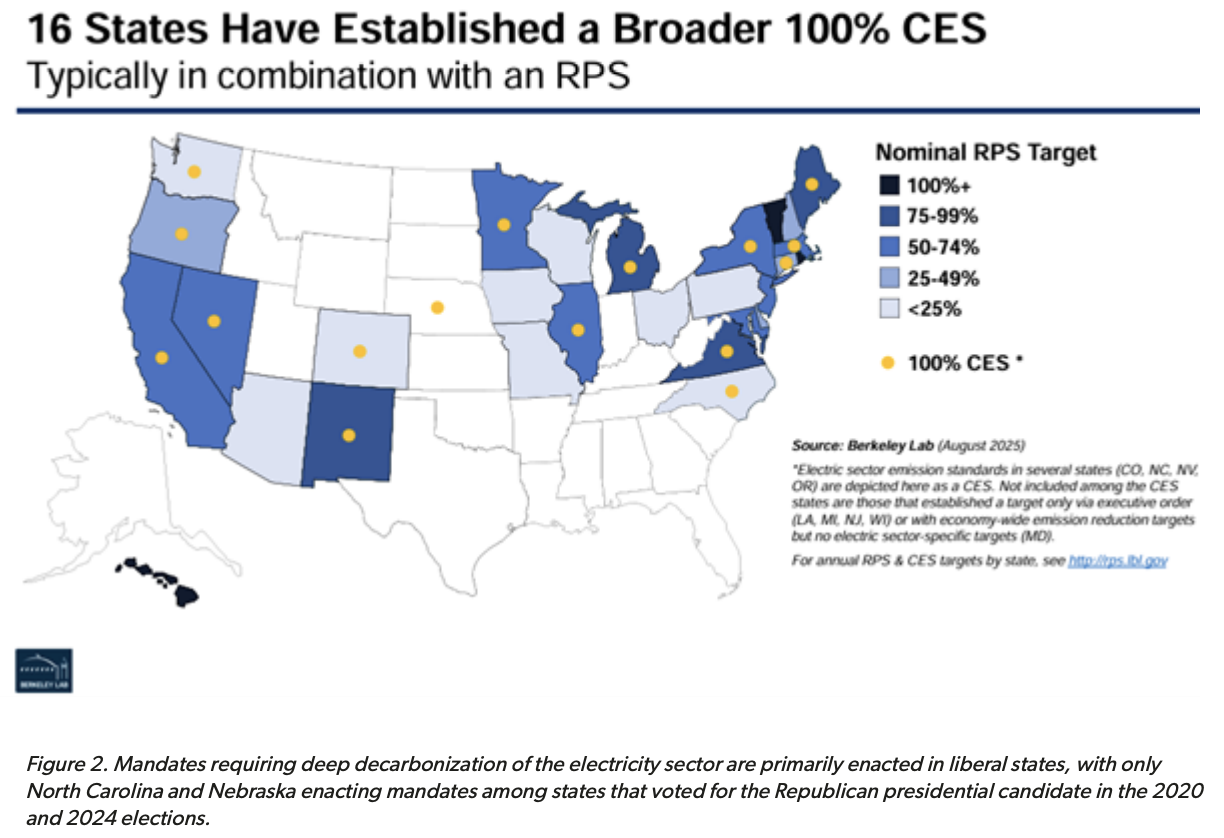
According to Lawrence Berkeley National Labs, each of the top five most expensive states for electricity have mandates requiring 100% of their power to come from renewable or carbon-free sources, making their electricity unnecessarily more expensive. These, and other mandates, such as net metering requirements, are driving up prices across America (see Figure 2).
In contrast, eight out of 10 states with the lowest electricity prices are reliably red, and seven of these states have no 100% carbon-free mandates. Additionally, 20 of 25 states with the lowest electricity prices are Red states; only four are blue, and one is purple (see Table 1, Appendix).
State Spotlights
Each state’s energy mix and regulatory structure is unique. The state spotlights below highlight how policies enacted in state legislatures impact the cost of electricity for their constituents.
New York
Federal data show New York’s electricity prices were 58% higher than the national average and 62% higher than Florida’s, based on the average all-sectors rate from January 2025 to August 2025.
Furthermore, a study from the left-leaning Progressive Policy Institute (PPI) found New York has experienced some of the fastest increases in electricity prices in the country. Retail electricity prices for residential customers increased by 36% between 2019 and 2024, nearly three times faster than the national average and the second-fastest increase in the country during this period, after California. PPI determined that electricity is expensive in New York due to a wide range of factors, but the report clearly explains: “The convergence of shrinking supply and rising demand inevitably leads to upward price pressures for consumers. These costs are compounded by the immense capital investment required to transform the grid and specific policy choices that increase the cost of energy production [emphasis added].”
For example, New York’s Climate Leadership and Community Protection Act (CLCPA) constitutes a massive renewable energy mandate, requiring the state to produce 70% of its electricity from renewable sources by 2030 and 100% by 2040, which will require substantial capital investments financed by ratepayers.
At the same time, the state’s firm capacity is being diminished by the premature closure of the Indian Point nuclear power plant, the state’s decision to deny the expansion of needed natural gas pipelines, and the state Department of Environmental Conservation’s decision to block a number of necessary upgrades for natural gas power plants, which the New York Independent System Operator (NYISO) warns could cause an increased risk of power shortages over the next five years.
Prices are also rising in response to state policies mandating the electrification of buildings and transportation, which are straining New York’s already overburdened grid and necessitating additional infrastructure buildouts. The state also suffers from natural gas supply issues due to its decision to ban hydraulic fracturing. In addition, ratepayers effectively pay a tax on carbon dioxide emissions as part of the Regional Greenhouse Gas Initiative. The expenses associated with these policies are projected to be so large that New York Governor Kathy Hochul delayed implementing the state’s capand-tax mandates under the 2019 climate law. The state claimed the regulations would be “infeasible” because they would impose “extraordinary and damaging costs upon New Yorkers.” The Governor has approved two natural gas pipelines as part of a rumored deal with the Trump administration to approve offshore wind facilities.
These policy reversals beg the question: If Democratic policies make energy so affordable, why are they backtracking from them?
California
California’s electricity rates are the second-highest in the nation. Rates are double the national average. Governor Newsom and California’s state legislature have embraced numerous policies that intentionally increase electricity rates, including a carbon dioxide reduction mandate, renewable mandates, solar cost-shifting (net metering), nuclear reactor closures, and EV charging subsidies, to name a few. Instead of trying to expand electricity generation to meet the energy needs of Californians, California is second in the country in electricity imports, as it embeds policy goals in electric rates to drive social policy. This is a toxic mix for California’s ratepayers.
California is second in the nation in total electricity generation from renewable resources and leads the country in utility-scale solar generating capacity. California’s generation mix is 42% natural gas, 39% non-hydroelectric renewables, 12% hydroelectric, and 7% nuclear.
California’s sky-high electricity rates are not the result of scarcity, or being in the middle of the Pacific Ocean like Hawaii, but rather are the direct consequence of policies that deliberately sidelined reliable, conventional fuels (including large hydropower) in favor of mandating and subsidizing preferred renewables. In 2002, Senate Bill (SB) 1078 created the Renewable Portfolio Standard, starting with a 20% renewables requirement by 2017. In 2006, Assembly Bill (AB) 32, the Global Warming Solutions Act, capped greenhouse gas emissions, forcing the state to adopt more wind and solar generation. Billions in rooftop-solar subsidies followed through the California Solar Initiative and other rooftop solar incentives, which have caused massive costshifting. In 2015, SB 350 raised the RPS target to 50% by 2030; in 2018, SB 100 pushed it to 60% by 2030 and 100% “carbon-free” electricity by 2045. In 2020, Governor Newsom issued an executive order creating a goal for all new cars sold in 2035 to be zero-emission vehicles, and the California Air Resources Board implemented that executive order by adopting the Advanced Clean Cars II regulation. The Advanced Clean Cars II regulation required a waiver under the Clean Air Act from the federal government. The waiver was granted by the Biden administration, but Congress later rescinded the waiver. The waiver would have allowed California to set strict emissions standards, forcing more demand on the grid by effectively banning the internal combustion engine in the state. California’s experience demonstrates that aggressive renewable energy mandates and climate policies entail steep costs borne directly by ratepayers. The state’s electricity rates, now double the national average, are not an unfortunate side effect but the predictable outcome of deliberate policy choices that prioritize emissions reduction over affordability.
Florida
Among the nation’s most populous states, Florida is a clear outlier for electricity affordability. Florida ranks as the second-largest electricity producer in the United States, trailing only Texas. Florida’s subtropical climate, characterized by hot, humid summers, mild winters, and a hurricane season, presents unique challenges for providing affordable electricity. Its residential sector stands out nationally: virtually every household relies on electricity for air conditioning, and about 90% use it for home heating. As a result, Florida homes account for 54% of the state’s total electricity consumption, the highest residential share of any state.
Despite these intense demands, Florida delivers electricity at prices 2% below the U.S. average at 13.27 cents per kWh for all sectors. It achieves this mainly by generating 75% of its power from natural gas, even though the state has no significant natural gas production of its own and must import virtually all of it. This traces directly to policy choices made under uninterrupted Republican control of the governorship and both legislative chambers since 1999. During the shale revolution that began around 2008, Florida pursued natural gas generation, raising its share from about 40% in 2005 to 75% today. Florida has been successful by avoiding the aggressive climate mandates adopted by most high-cost blue states. At the same time, the state manages to maintain these relatively low prices despite frequent hurricanes that regularly damage transmission lines, substations, and power plants, forcing ongoing investments in storm hardening and rapid restoration that add to overall grid expenses.
Louisiana
In 2025, Louisiana had the third-lowest electricity rates in the United States. The reasons are simple—73% of Louisiana’s electricity is generated by natural gas and unlike California or New York, Louisiana has not attempted to implement carbon dioxide or renewable energy goals through its electricity generation system.
Louisiana is very strong in natural gas production and infrastructure, and it leverages that strength to protect ratepayers; it is the third-largest natural gas producer in America. Louisiana has a very strong pipeline network because it is home to the best-known natural gas market center in North America – Henry Hub. Low natural gas prices in the United States lead to low electricity prices in Louisiana. Besides natural gas, 16% of the state’s electricity is generated by nuclear power, 6% by coal, 4% by non-hydroelectric renewables, and 1% by hydroelectric power.
Louisiana’s approach to electricity regulation stands in stark contrast to states like New York and California, which have pursued aggressive climate policies, and the results are reflected in ratepayers’ bills. By prioritizing affordability and reliability over mandates, Louisiana has maintained some of the nation’s lowest electricity rates. The state’s regulatory framework allows utilities to select generation resources based on economic fundamentals rather than political preferences, avoiding the costly mandates, emissions caps, and renewable portfolio standards that drive up rates elsewhere.
Kentucky
In 2025, Kentucky had the 13th-lowest electricity rates in the United States and the lowest rates of any state east of the Mississippi River. Kentucky’s rates are 21% lower than the national average. The reasons are straightforward—67% of Kentucky’s electricity is generated by coal and 26% by natural gas. Unlike states such as California or New York, Kentucky has not burdened ratepayers with the carbon dioxide reduction mandates or renewable energy requirements that inflate electricity costs.
Kentucky leverages its abundant coal resources to maintain affordable electricity for families and businesses. As the nation’s seventh-largest coal producer, Kentucky is home to about one out of five operating U.S. coal mines, more mines than any other state except West Virginia and Pennsylvania. This robust coal infrastructure allows the state to generate 67% of its utility-scale electricity from coal, the second-largest share of any state after West Virginia.
Kentucky has also developed significant natural gas infrastructure to complement its coal generation. The state has 22 underground natural gas storage sites capable of holding almost 222 billion cubic feet of gas. In 2024, natural gas-fired power plants generated 26% of Kentucky’s electricity, more than nine times greater than a decade earlier. The remaining 7% of Kentucky’s generation comes from hydroelectric and non-hydro renewables. Kentucky’s pragmatic approach to electricity regulation prioritizes ratepayers’ needs over political agendas. By allowing utilities to leverage the state’s abundant coal resources while incorporating natural gas for flexibility, Kentucky has maintained low electricity rates. This is important for Kentuckians as more than half of Kentucky households use electricity for heating.
Conclusion
Electricity affordability is a function of state-level policy choices. States that have embraced aggressive renewable mandates, 100% “carbon-free” targets, premature coal and nuclear retirements, rooftop-solar cost shifting, and restrictions on natural gas infrastructure routinely deliver the nation’s highest electricity prices. California and New York, the poster children for this approach, now charge their residents and businesses significantly more than the national average, with price increases that have consistently outpaced the rest of the country.
In contrast, states that have prioritized dispatchable, affordable generation consistently deliver the lowest electricity prices. Florida keeps rates below the national average despite near-universal airconditioning demand and frequent hurricanes. Louisiana enjoys the third-lowest rates in the nation while utilizing its abundant natural gas resources. Both states have done so under sustained Republican governance that has largely rejected the renewable mandate model.
Americans pay dramatically different electric bills depending on which party controls their state capitol. High electricity prices are not an inevitability; they are a choice. And in state after state, they are a choice made by left-wing policymakers who have prioritized climate symbolism over working families’ budgets.
When even deep-blue New York is forced to delay its own cap-and-tax scheme because it would impose “extraordinary and damaging costs” on residents, and when California ratepayers are paying double the national average to subsidize an electricity system that still imports power from neighboring states, the verdict is in. Americans struggling with utility bills need the same thing Florida and Louisiana residents already have: state leaders willing to put affordability and reliability ahead of ideological mandates. Until more states follow the red-state model, millions of households and businesses will continue to pay the price for expensive electricity as a deliberate political choice.
Additional Resources
- Mitch Rolling and Isaac Orr, “The Rhyme and Reason Behind Rising Electricity Prices,” Energy Bad Boys, November 22, 2025
- “New York Is Missing Its Climate Mandates Despite Paying High Electricity Prices to Meet Them,” Institute for Energy Research, December 5, 2025
- Caleb Jasso, “California, the Energy Island,” Institute for Energy Research, July 29, 2025
- “The Challenges and Costs of Net-Zero and the Future of Energy,” Institute for Energy Research, August 9, 2023
- Isaac Orr and Mitch Rolling, “Eight Slides on the Future of Electricity Prices,” Energy Bad Boys, November 15, 2025
- Caleb Jasso, “California’s Green Gambit: A Timeline,” Institute for Energy Research, November 19, 2025
- Isaac Orr and Mitch Rolling, “The Top Eight Takeaways for the Lawrence Berkeley/Brattle Factors Influencing Electricity Prices Study,” Energy Bad Boys, October 25, 2025
- “Florida Has Low Prices, No Green Policies,” Institute for Energy Research, October 22, 2024
Appendix
All-sector electricity rates by state from January 2025 through August 2025 were obtained from the U.S. Energy Information Administration Electricity Data Browser.