

Key Takeaways
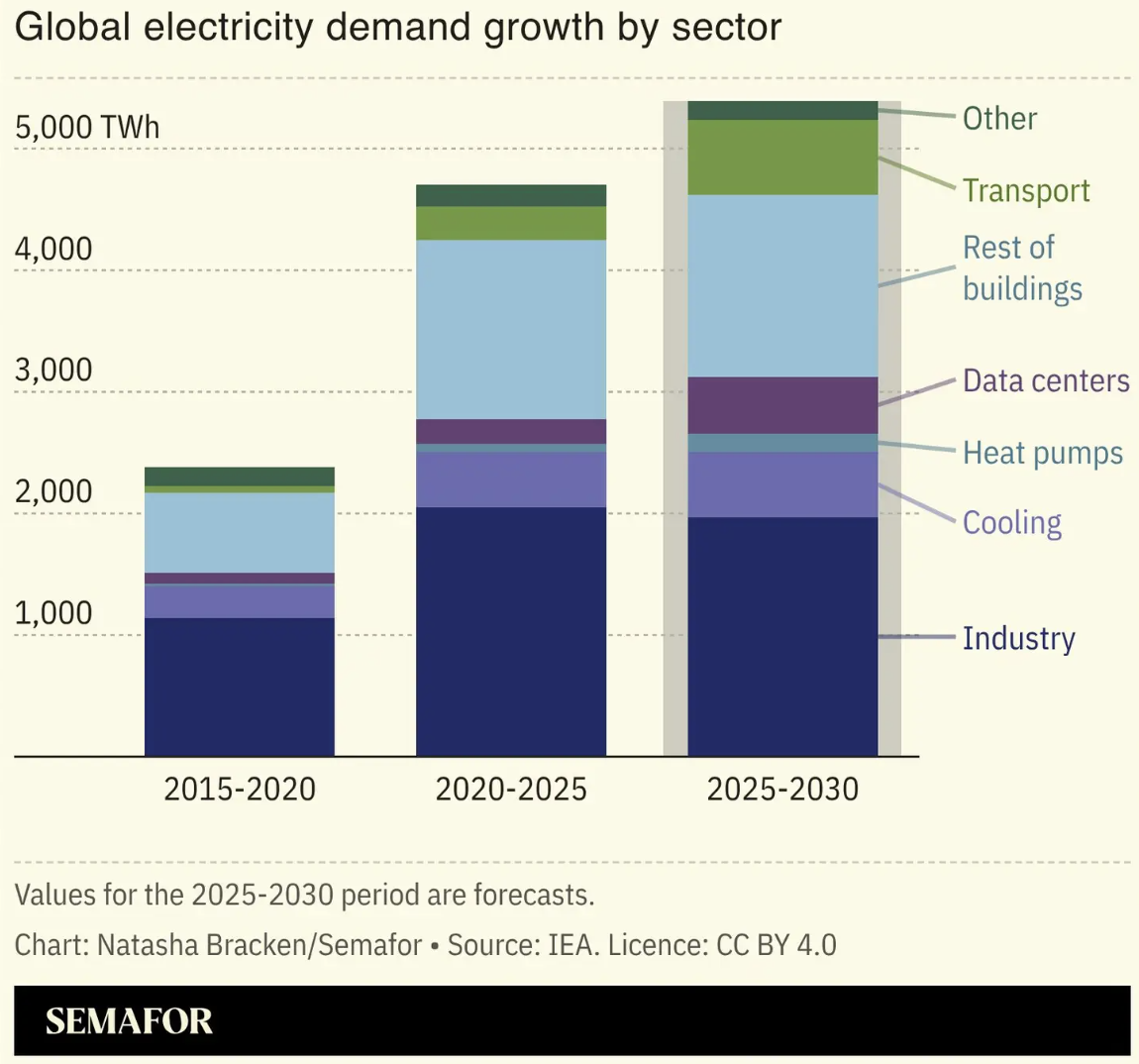
The International Energy Agency (IEA) expects average electricity demand worldwide to grow by more than 3.5% a year through this decade, driven by industry, AI data centers, air conditioning, and electric vehicles.
The IEA expects electricity demand to grow at least 2.5 times faster than total energy demand over the next five years, with both emerging economies and advanced economies contributing to the growth.
One of the biggest challenges facing most economies is grid connectivity as record-high amounts of capacity await being connected to the grid.
The IEA estimates that annual investment in electricity grids will need to rise by about 50% by 2030 to keep pace with demand growth.
Affordability is also becoming a big political problem as residential electricity prices in many countries have risen faster than incomes since 2019, and high electricity costs are forcing energy‑intensive industries to move offshore, mainly due to government policies.
According to the International Energy Agency (IEA), global electricity demand is expected to grow by over 3.5% per year on average through this decade, driven by industry, electric vehicles, air conditioning, and data centers. Electricity demand growth is forecast to rise faster than overall energy demand and far quicker than electric grid expansion in many regions. The IEA estimates that annual investment in electricity grids will need to rise by about 50% by 2030 to keep pace with demand growth. A big challenge facing most economies is grid connectivity as record-high amounts of capacity await being connected to the grid. In many cases, however, those queues are made up of intermittent wind and solar capacity that contribute very little to peak demand.
IEA expects power demand to grow at least 2.5 times faster than total energy demand over the next five years, with both emerging economies and advanced economies contributing to the growth. Wealthy countries are expected to account for about one-fifth of the total increase in global power demand through 2030, after 15 years of relatively flat consumption, driven by artificial intelligence (AI) data centers and increased electrification pushed by their political leaders. According to IEA Director of Energy Markets and Security Keisuke Sadamori, “In this Age of Electricity, the increase in global power consumption through 2030 is set to be equivalent to adding more than two European Unions.”
The Grid Challenge
According to Electrek, over 2,500 gigawatts of projects worldwide — including renewables, expensive battery storage, and AI data centers — are in grid connection queues. The IEA claims that up to 1,600 gigawatts could connect in the near term by deploying grid-enhancing technologies and updating grid connection rules, which would make better use of existing infrastructure while longer-term grid expansions are under development.
Expensive utility-scale battery storage has been added in California, Texas, Germany, South Australia, and the UK, which allows excess power to be stored for later usage that could help with power shortages. Battery storage systems, as mentioned above, are very expensive, however. The Energy Information Administration quotes their levelized cost on average to be $126 per megawatt hour — double the cost of new natural gas combined cycle and quadruple the cost of new solar PV. As with wind and solar, the amount of power battery storage can deliver is dependent on the electricity available to charge them and how much power they can hold.
China has plans to install 180 gigawatts of battery storage systems by the end of 2027, with a direct project investment of $35.2 billion. China’s installed battery storage base at the end of 2024 totaled 73.8 gigawatts, 40% of the global total. If China reaches its goal, the country would have almost as much battery storage installed by the end of 2027 as the entire world did through September 2025, when total operational battery storage capacity globally hit 189 gigawatts — a 28% increase over 2024. Despite media and other reports that China is into “green energy,” the country is still using coal to power its economy, with about 80 to 100 gigawatts of coal-fired capacity added in 2025. The Statistical Review of World Energy reports that coal accounted for 58% of China’s primary energy consumption in 2024, with fossil fuels accounting for a whopping 88%.
Electrek reports that the IEA notes that there are growing risks to grid security and resilience, including aging infrastructure, weather, cyber threats, and physical attacks. According to the IEA, for power systems to handle the next wave of electrification, grid operations need to be modernized and critical infrastructure protections strengthened.
Electricity Affordability
Affordability is becoming a big political problem as residential electricity prices in many countries have risen faster than incomes since 2019, and high electricity costs are forcing energy‑intensive industries to move offshore. The rising power costs are the highest in Western countries that are transitioning to “green technologies.” The policies put in place to further the transition have resulted in escalating consumer prices along with demand growth. Further, the governments must support “green technologies” with massive subsidies to make them profitable, making them even more costly.
Analysis
Even with the U.S. moving away from the broad electrification of the economy pursued by the Biden administration, global demand for electricity will continue to grow. Relying on reliable energy sources to supply this electricity is crucial for economies to avoid overly burdening consumers with higher electricity prices, as “green” sources are often redundant and divert investment from the capacity the grid relies on. The differences in electricity prices across U.S. states make this point clear. As we explain in Blue States, High Rates, the policies of blue states have driven residential electricity costs to skyrocket compared to those in red states. Blue states have standards mandating a certain percentage of electricity from renewable energy and cap-and-trade policies that tax fossil fuels used in electric generation, among other policies.
For inquiries, please contact [email protected].

