

Key Takeaways
Asian nations are increasing coal use to replace LNG amid escalating attacks on energy infrastructure in the Iran conflict.
Coal prices have risen 14%, but LNG prices doubled even before Iran’s recent attack on Qatar’s LNG facility at Ras Laffan, the world’s largest LNG export facility, that was in retaliation for Israel striking Iran’s South Pars gas field.
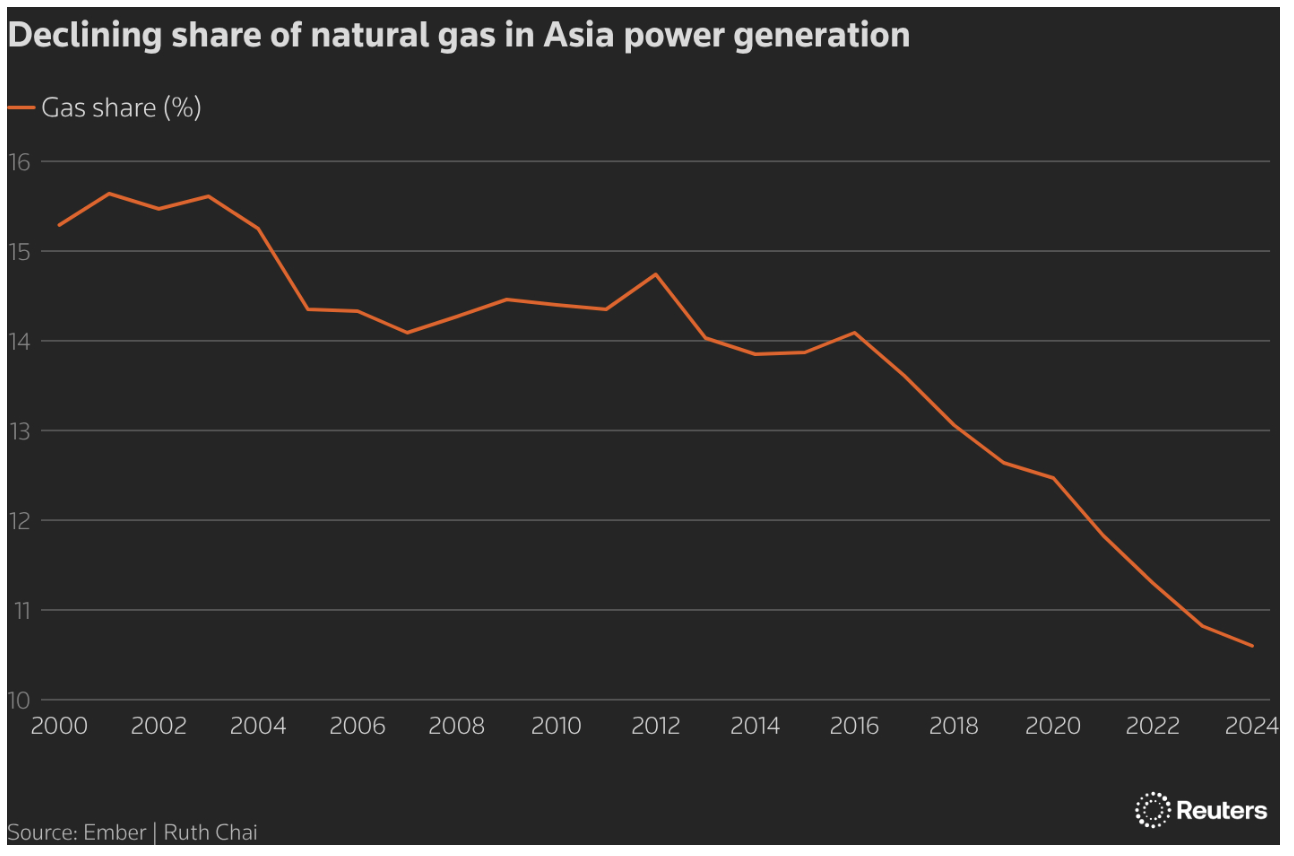
LNG’s share of electricity generation in Asia has been falling for years, accelerating after Russia’s invasion of Ukraine drove up prices, leading to demand destruction.
The Trump administration has asked Israel to cease attacks on energy infrastructure in Iran and warned Iran that further attacks on energy infrastructure in the region would result in U.S. attacks on their South Pars gas field, which they share with Qatar, the world’s largest.
While oil and gas prices are surging, Asia is turning to coal, whose prices have increased by around 14%. At the same time, liquefied natural gas (LNG) spot prices have doubled due to the effective closure of the Strait of Hormuz and the shut-in of LNG facilities in Qatar. Now, the situation is even worse as a major gas field in Iran was struck by Israel, and Iran retaliated on energy facilities in the Middle East. Reuters reports that Iranian aerial attacks have caused extensive damage to the world’s largest gas plant in Qatar, targeted a refinery in Saudi Arabia, forced the United Arab Emirates to shut gas facilities, and set off fires at two Kuwaiti refineries and one in Haifa, Israel. Iran’s parliament speaker, Mohammad Bagher Ghalibaf, said an “eye for an eye” approach is now in effect, as “a new level of conflict has begun.”
Asia Turns to Coal
Several countries in Southeast Asia are turning to coal. According to government data, Bangladesh is increasing coal power generation and coal-fired power imports in March, Reuters reports. Pakistan is increasing the power generated from domestic sources, including coal. The Philippines is ramping up coal-fired power and slashing LNG-fired output. Vietnam is negotiating coal supply, and Thailand is increasing generation from its largest coal plant to preserve LNG. South Korea plans to remove output ceilings on coal-fired power and increase nuclear generation, while Japan’s top utility intends to maintain high utilization rates for coal-fired power.
LNG Demand Destruction
According to Reuters, war-driven supply disruptions are expected to trigger LNG demand destruction across Asia, with prices likely to remain elevated and volatile even after the conflict. High LNG costs following Russia’s invasion of Ukraine and shortages in city gas pipeline networks have led to cancellations and delays of proposed LNG import capacity in South Asia, where $107 billion in infrastructure investments could be at risk. Via Wood Mackenzie, “The conflict will significantly reduce Asian LNG demand growth in 2026.” Wood Mackenzie cut its annual forecast for Asian LNG imports to about five million metric tons from 12.4 million tons, assuming a two-month disruption to Middle East supply.
Recent Attacks on Middle East Energy Facilities
Israeli airstrikes hit the infrastructure of the South Pars offshore gas field, Iran’s largest source of natural gas, a gas field that is shared by Iran and Qatar. South Pars is Iran’s largest domestic energy source, supplying 80% of its natural gas needs. Iran relies on natural gas to produce electricity and heat homes, even though it has huge energy reserves; it has suffered power shortages because of gas supply interruptions caused by poor infrastructure. In July, public buildings had to shut down when a heat wave strained the power grid. Iran is the fourth-largest global consumer of natural gas, behind the United States, China, and Russia. In contrast to other Middle East countries, it uses gas for heating due to its cold climate, and much of it is subsidized. Iran also supplies natural gas to Iraq, which accounts for about one-third of Iraq’s energy needs, and Iraq’s electric power supply was disrupted due to the strike on the gas field.
According to the Associated Press, Qatar has invested billions in developing the South Pars field as a source of LNG, which it exported from its Ras Laffan facility before the war. There, the gas is chilled to a liquid and loaded onto tankers that head for customers in Asia, who turn it back into gas. Qatar supplies about a fifth of the world’s LNG. Ras Laffan shut down on March 2nd after an Iranian attack and was then struck again on March 19th. The shutdown and attack raised natural gas prices in Asia and Europe.
In retaliation for the hit on South Pars, Iran attacked Qatar’s natural gas facilities in Ras Laffan Industrial City, one of Qatar’s major energy hubs, as Iran reported an airstrike on its oil and petrochemical facilities. The actions spiked oil prices and sent markets sliding. Reuters reports that the attacks caused “extensive damage” to several of QatarEnergy’s LNG facilities and to Shell-owned Pearl GTL, the world’s largest gas-to-liquids plant, with capacity to process up to 1.6 billion cubic feet per day of wellhead gas. Qatar produces 77 million metric tons annually of LNG; the Laffan refinery primarily processes condensate into refined products, including aviation fuel. While the United States did not know about the Israeli attack on South Pars, President Trump threatened to destroy Iran’s South Pars gas field if Qatar’s energy facilities were attacked again.
Other facilities recently attacked include a drone hit on the Aramco-Exxon refinery, SAMREF in Saudi Arabia, which also intercepted a ballistic missile launched towards the port city of Yanbu, which is currently its only outlet for oil exports and where the refinery is located. One of the operational units at Kuwait Petroleum Corporation’s Mina al-Ahmadi and Mina Abdullah refineries was targeted by drones, resulting in fires at both sites. The United Arab Emirates shut gas facilities after intercepting missiles. UAE authorities are responding to incidents at the Habshan gas facilities and at the Bab oil field caused by debris from intercepted missiles. The Habshan complex, operated by Abu Dhabi state oil giant ADNOC, is one of the world’s largest gas processing facilities, comprising five plants with a total capacity of 6.1 billion standard cubic feet per day.
Analysis
The fact that Asian utilities are increasing coal-fired power generation to cut costs and safeguard energy supply indicates a potential long-lasting consequence of the war. The latest attacks are dealing a major blow to crucial oil and natural gas infrastructure, potentially causing lengthy disruptions that could trigger another supply shock. Increases in output by various countries, including the United States, Canada, Argentina, Brazil, and Guyana, along with the 60-day waiver on the Jones Act, could help lower prices. However, mitigating the disruptions to oil and gas will likely require that the temporary increases and waivers become permanent.
For inquiries, please contact wrampe@ierdc.org.

