

Key Takeaways
Refinery closures in California are resulting in more sea-borne gasoline imports to the state.
California will soon have just 11 refineries after having 42 refineries 40 years ago.
Imports of California’s boutique gasoline fuel are coming from India, South Korea, and even the Bahamas, as West Coast refineries are shipping petroleum products to California via the Bahamas to comply with the Jones Act, which requires that U.S. goods be delivered by U.S. ships with U.S. crews.
There are only about 55 Jones Act-compliant oil tankers worldwide, compared with more than 7,000 oil tankers globally.
A new proposed pipeline, the Western Gateway Pipeline, could eliminate some of the sea-borne imports if it gets the permits and regulatory approvals needed, but new pipelines in the United States have been caught up in lawsuits and protests, despite being historically safer than marine transport.
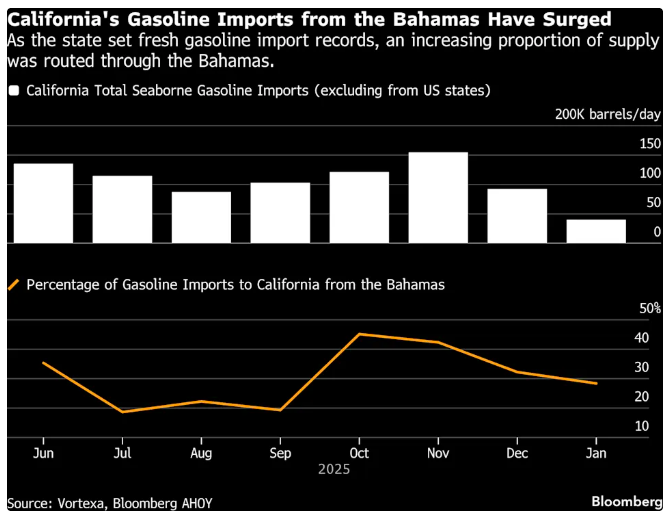
According to Bloomberg, in November, California imported more gasoline than ever before, with over 40% coming from the Bahamas, despite much of it being produced in the United States. In 2025, the Bahamas supplied 12% of California’s ship-borne gasoline imports, more than it had in the previous nine years combined. California must rely more and more on imported ship-borne gasoline because of refinery closures due to its onerous climate policies, a lack of petroleum pipelines, and the Jones Act, which requires U.S. ships and crews be used between U.S. ports carrying U.S. goods. Other countries, notably India and South Korea, also supply gasoline to California.
California has had as many as 42 refineries 40 years ago, and since 2000, its operational refineries dropped from 23 to 12 at the end of 2025. Phillips 66 shuttered its Los Angeles refinery in October, and Valero will shutter its Northern California refinery this spring, bringing the number of refineries in the state to 11. California’s environmental policies make it difficult for refineries to operate and make a profit, particularly as California Governor Newsom touts price gouging by oil companies as the reason for the state’s high gasoline prices, which are about $1.50 per gallon (57%) higher than the national average price. The real reasons for the state’s high prices are that California has the highest state gasoline tax in the nation at $0.709 per gallon, a cap-and-trade program that taxes fossil fuels, a low-carbon fuel program, underground gas storage fees, and a state and local sales tax. While it has oil resources and is the eighth largest producer of oil among the states, its oil production has gone down due to state policies. California’s oil output dropped from 760,000 barrels per day in 2000 to 250,000 barrels per day in 2025.
As Bloomberg explains, the 106-year-old Jones Act requires that goods shipped between U.S. ports must travel on U.S.-built, owned, and operated ships, which are in short supply and expensive to charter. There are about 55 Jones Act-compliant oil tankers worldwide, compared with more than 7,000 oil tankers globally. When California needs to import more gasoline than it can produce itself due to its shrinking refinery fleet, Gulf Coast refiners can obtain higher margins by first sending the product east to the Bahamas and then west to California, avoiding higher-cost U.S.-flagged shipping. While cheaper than the cost of using U.S. ships, the higher transportation costs from the ship-borne imports result in a higher gasoline price than if the product were refined in the state.
California requires a specialized boutique blend of gasoline to fuel its vehicles due to its environmental policies. According to Bloomberg, refineries in Asia are producing gasoline blend stock at the grade required by California, and the product can be shipped without transiting the Panama Canal and paying its transit fees, unlike imports coming from the Bahamas. Both India and South Korea supplied more gasoline to California last year than did the Bahamas. Removal of U.S. sanctions on Venezuela has resulted in an increase in regional freight prices, making foreign-flagged ships only about $1 cheaper than U.S. ships, compared to nearly $4 a barrel cheaper before the Maduro raid. If freight costs continue to rise, shipments of U.S. gasoline may not be able to compete with supplies from South Korea or India, given the Jones Act restrictions.
Bloomberg reports that, after Phillips 66 shuttered its Los Angeles refinery in 2025, gasoline imports rose to the highest level since at least 2016. With no fuel pipelines currently connecting the Gulf to the West Coast, California will need to depend on imports for at least the next several years. A pipeline is being proposed to carry gasoline and other petroleum products from Illinois to California, much like the Colonial Pipeline provides petroleum products from Gulf Coast refineries to the Northeast. It will supply gasoline as well as important distillate products.
The proposed Western Gateway Pipeline, which is expected to be completed by 2029, pending the receipt of all permits and regulatory approvals, would be the world’s largest fuel conduit. The pipeline network would cross from Illinois through Oklahoma, Texas, New Mexico, Arizona, and Nevada to California and adjacent markets, with connectivity to Las Vegas, Nevada. Much of the pipeline would be built along or utilize existing Kinder Morgan conduits, with a new section across New Mexico. The section of the pipeline that would cross near Mescalero Apache land in New Mexico has received buy-in from local tribes, but past endeavors at building pipelines have often been caught up in lawsuits and protests.
Analysis
California’s anti-energy policies have created an unenviable situation where it has to rely on expensive imports for products that it could more cheaply produce in-state. As we’ve written previously, “This is what it looks like when ideology overrides energy reality. Governor Newsom has made California a case study in how to destroy a state’s energy sector — and make its residents pay more for the privilege. The rest of America should take note.”
For inquiries, please contact [email protected].

