

Key Takeaways
Joint U.S. and Israeli military strikes on Iran began late February 28, 2026, targeting leadership (including the killing of Supreme Leader Ayatollah Ali Khamenei), nuclear facilities, missile sites, and military infrastructure. President Trump indicated the campaign could last weeks or longer.
On March 2, 2026, Brent crude futures rose to $78–80 per barrel (up 7–9%), and WTI to $70–73 (up 6–8%). This single-day increase is modest historically; inflation-adjusted prices remain low compared to past peaks.
Shipping traffic in the Strait of Hormuz dropped over 80%.
Markets are pricing in multi-week disruption rather than indefinite crisis as U.S. energy security from growing production offers stability.
Oil futures rose on Monday following joint U.S. and Israeli military strikes on Iran over the weekend, as the escalating conflict expanded across the Middle East and raised fears of disruptions to global energy supplies.
The attacks, which began late February 28, 2026, targeted Iranian leadership, including the killing of Iran’s leader, Ayatollah Ali Khamenei. Other targets within Iran included nuclear facilities, missile sites, and military infrastructure, with President Donald Trump signaling that the campaign could extend for weeks or longer.
Iran retaliated with missile and drone strikes on U.S. bases, Israel, and allied targets in the region, including incidents affecting oil and gas facilities in Saudi Arabia and Qatar. Additionally, Tehran also declared the Strait of Hormuz effectively closed, halting much of the tanker traffic through this critical chokepoint for roughly one-fifth of the world’s oil shipments.
Impact on Oil Prices
As of March 2, 2026, Brent crude futures have risen and are trading between $78 and $ 80 per barrel. West Texas Intermediate (WTI) crude has traded in the $70 to $73 range. These levels reflect an initial market reaction of roughly 7–9% for Brent and 6–8% for WTI.
As Javier Blas at Bloomberg points out, a single-day increase of approximately 6.3% in WTI and 6.7% in Brent prices would be modest by historical standards. Additionally, in inflation-adjusted terms, prevailing prices remain subdued relative to prior market disruptions. To put it in perspective, the nominal high of $145 per barrel in mid-2008 equates to approximately $220 in 2026 dollars, underscoring that despite the scope of the conflict, current prices remain relatively low. Therefore, for the time being, Iran’s capacity to exert effective leverage in the oil market appears constrained, and at WTI levels around $70–73, global oil prices do not impose significant economic pressure on the U.S.
The reason for this energy security is straightforward: North America possesses enormous energy reserves, and advancing technology has made it possible to tap into more of them at increasingly affordable costs. The shale revolution in the U.S., fueled by innovations in hydraulic fracturing and horizontal drilling, led to massive increases in production. Combined with rising output from Canada, this surge revitalized North America’s role in the global oil market. North American crude has emerged as a key stabilizing force for worldwide oil prices, and greater supply from stable, reliable producers such as the U.S. and Canada has helped erode the OPEC cartel’s traditional dominance of global pricing.
Strait of Hormuz and Middle East Supply Disruption
The Strait of Hormuz, which facilitates approximately one-fifth of global seaborne oil trade and substantial volumes of liquefied natural gas, has experienced near-total commercial disruption and is the main driver of rising prices. According to a report from Hill Dickinson, Iranian Revolutionary Guard Corps broadcasts via VHF have warned that the strait is closed and threatened to target vessels attempting passage, contributing to the de facto shutdown despite technical openness. Overall vessel traffic through the strait has declined by over 80% in some assessments, with Kpler AIS data showing only limited passages, primarily by Iranian- and Chinese-flagged vessels or dark-fleet vessels.
According to Reuters, over 150 vessels, including oil and LNG tankers, have anchored or clustered in surrounding waters on either side of the strait. Multiple commercial tankers (at least four to five reported) have been struck by missiles or drones in the Strait and Gulf of Oman, resulting in damage, fires, personnel casualties, and heightened electronic interference. Additionally, Bloomberg reported that major protection and indemnity clubs have canceled or withdrawn war-risk coverage for Persian Gulf voyages, rendering transits commercially prohibitive for most operators. Major shipping lines (e.g., Maersk, Hapag-Lloyd, CMA CGM) have suspended Gulf transits, rerouted via the Cape of Good Hope, or imposed emergency surcharges. Crude loading from principal Gulf exporters such as Saudi Arabia, UAE, Kuwait, Qatar, and Iraq faces increasing constraints as precautionary or forced shutdowns have affected facilities. Qatar has halted LNG production following strikes on gas sites, and Bloomberg reported that Saudi Arabia’s Ras Tanura refinery has shut down after a drone attack.
According to the EIA, Saudi Arabia exports more crude oil and condensate through the Strait of Hormuz than any other country, accounting for the largest share of transit flows, approximately 38%, or around 5.5 million barrels per day, in recent 2024 data, with similar patterns persisting more recently. Saudi Arabia and the United Arab Emirates operate pipelines that bypass the Strait of Hormuz entirely. These include Saudi Arabia’s East-West Pipeline (Petroline) to the Red Sea port of Yanbu and the UAE’s Habshan-Fujairah pipeline to the Gulf of Oman coast. These routes provide alternative export options during disruptions in the strait. The pipelines generally do not run at full capacity under normal conditions, leaving substantial spare capacity, which could help offset some transit interruptions by redirecting volumes away from the strait.
Analysis
While the conflict has driven a sharp but historically moderate spike in oil prices and severely disrupted the Strait of Hormuz, North America’s production strength provides meaningful resilience against prolonged supply shocks. For now, markets are pricing in a multi-week disruption rather than an indefinite crisis, with American energy abundance continuing to serve as a critical global buffer.
Late on Monday evening, Secretary of State Marco Rubio announced the administration will release a plan on Tuesday to calm oil markets. However, as today’s market reaction shows, North American production, and the U.S. in particular, is already providing stability for global oil markets. Unlike past oil price spikes, such as during the 1973 Yom Kippur War, the 1979 Iranian Revolution, the 1990 Persian Gulf War, and the 2007 Financial Crisis, U.S. and North American oil production has been growing as a percentage of total global production, giving the market greater security than in the past.
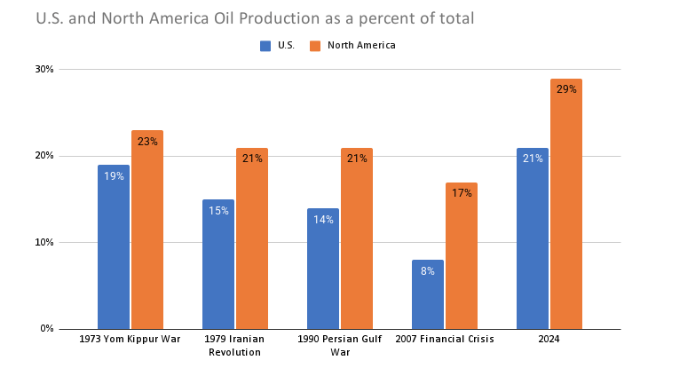
Source: Energy Institute, 2025 Statistical Review of World Energy
While escalation risks persist, including potential for higher prices, the combination of diversified supply sources, alternative export routes, and North American production resilience provides significant safeguards against severe, sustained economic damage.
For inquiries, please contact astevens@ierdc.org.

